
Key takeaways:
Cholesterol gets a bad rap. For decades, we've heard that it clogs arteries and causes heart attacks. But here's what doesn't make headlines: your brain contains 25% of your body's total cholesterol despite making up only 2% of your body weight. As lipid expert Dr. Tom Dayspring puts it, "Cholesterol is almost certainly the most important molecule in the brain."
So how can cholesterol be both necessary for brain function and a major cardiovascular risk factor? The answer lies in understanding where cholesterol is, how it gets there, and what form it takes.
In this post, we're taking a deeper dive into cholesterol than usual. We'll break down what your cholesterol numbers actually mean, why the standard tests miss critical information, and how the cholesterol story connects cardiovascular health to brain health.
The Basics: What Is Cholesterol?
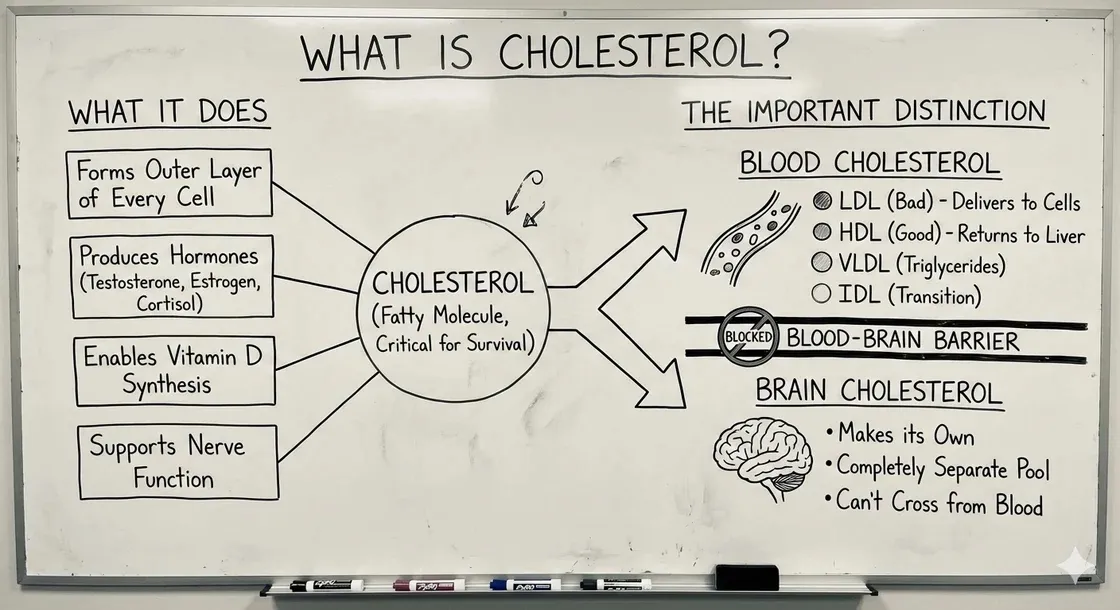
Cholesterol is a fatty molecule that serves critical functions throughout your body. It forms the outer layer of every cell, helps produce hormones (including testosterone, estrogen, and cortisol), enables vitamin D synthesis, and supports nerve function. Without cholesterol, you simply couldn't survive.
But there's an important distinction to make: "cholesterol" isn't one thing.
When we talk about cholesterol in the blood versus cholesterol in the brain, we're really talking about two separate systems that operate differently.
Blood cholesterol: Cholesterol travels through your bloodstream inside particles called lipoproteins. These particles come in different types:
- LDL (low-density lipoprotein): Often called "bad" cholesterol, LDL particles deliver cholesterol to cells throughout your body
- HDL (high-density lipoprotein): Called "good" cholesterol, HDL particles help transport excess cholesterol back to the liver
- VLDL (very low-density lipoprotein): Primarily transports triglycerides but also carries some cholesterol
- IDL (intermediate-density lipoprotein): A transition form between VLDL and LDL
Brain cholesterol: Your brain makes its own cholesterol and keeps it completely separate from blood cholesterol. The blood-brain barrier prevents cholesterol in your bloodstream from entering your brain. This means the cholesterol circulating in your blood and the cholesterol in your brain are part of two entirely different pools.
The Heart Risk: Why apoB Matters More Than LDL?
What is apoB?
ApoB (apolipoprotein B) is a protein found on the surface of all atherogenic (plaque-forming) particles, including LDL, VLDL, IDL, and Lp(a). Each particle contains exactly one apoB molecule, making apoB a direct count of total potentially harmful particles.
Why apoB beats LDL cholesterol?
Traditional LDL-C (LDL cholesterol) tells you how much cholesterol LDL carries, but not how many particles you have. Two people can have identical LDL-C but vastly different particle numbers and risk levels.
- Many small LDL particles (each carrying less cholesterol) = "normal" LDL-C but high particle count and high risk
- Fewer large LDL particles (each carrying more cholesterol) = higher LDL-C but fewer particles and potentially lower risk
ApoB counts every atherogenic particle regardless of size. This makes it the best single marker for cardiovascular risk.
What is the triglyceride connection?
Elevated triglycerides (often from insulin resistance) fundamentally alter lipid metabolism:
- VLDL becomes triglyceride-enriched
- Particles get remodeled into small, dense LDL
- ApoB particle count increases
- You can have "normal" LDL-C but dangerously high apoB
This is why metabolic health is critical for cardiovascular risk.
The Brain Side: Why Cholesterol Is Essential
While high apoB threatens your heart, brain cholesterol is absolutely essential.
Critical brain functions
- Myelin formation: Insulates nerve fibers for rapid signal transmission
- Synapse formation: Creates and maintains neuron connections
- Cell membranes: Every neuron needs cholesterol-rich membranes
- Neurotransmitter release: Regulates how neurons communicate
How the brain gets cholesterol
Astrocytes (brain cells) produce cholesterol and package it into brain-specific lipoproteins containing apoE (apolipoprotein E) for delivery to neurons.
The APOE genetic factor
- APOE ε2: Protective against Alzheimer's, better cholesterol handling
- APOE ε3: Most common, considered neutral
- APOE ε4: Increases Alzheimer's risk, disrupts brain cholesterol metabolism
Research from MIT shows APOE4 is associated with brain cells accumulating cholesterol abnormally rather than using it to make healthy myelin. This isn't about too much or too little cholesterol, but how effectively the brain uses it.
Cholesterol and Alzheimer's
Brain regions vulnerable to Alzheimer's show signatures of being "super cholesterol-hungry," as researchers describe it, constantly trying to produce and absorb cholesterol. When this system fails (especially with APOE4), neurodegeneration may follow.
The Paradox Resolved
In the bloodstream: High apoB drives atherosclerosis. Particles penetrate artery walls, oxidize, trigger inflammation, form plaques. Goal: Keep apoB low (<60-80 mg/dL) to prevent cardiovascular disease.
In the brain: The brain makes its own cholesterol independently. Blood cholesterol can't cross the blood-brain barrier. Goal: Support healthy brain cholesterol metabolism through metabolic health.
This separation means lowering blood cholesterol doesn't starve your brain. Your brain continues making what it needs regardless of apoB levels.
The Bottom Line
Cholesterol isn't inherently good or bad; context is everything. In your bloodstream, high apoB poses serious cardiovascular and cerebrovascular risks. In your brain, cholesterol is essential for structure and function.
The good news: these systems are separate. Lowering apoB to protect your heart doesn't harm your brain. In fact, protecting your cardiovascular system through better lipid management, metabolic health, and inflammation control also protects your brain.
Understanding which biomarkers matter empowers informed decisions. It's not about fearing cholesterol; it's about managing it intelligently.
Want to Understand Your Complete Lipid Profile and Genetic Risk?
BetterBrain includes apoB, advanced lipid testing, metabolic biomarkers, and APOE genetic testing for a complete cardiovascular and brain health picture.