

Key takeaways:
Most clients pay $0 with employer sponsored insurance.
pTau-217: What the Alzheimer's Blood Test Can and Can't Tell You
A simple blood draw can now flag Alzheimer's-related changes in the brain years before any symptom appears. For some people that is welcome news, an early window to act. For others it raises a harder question they are not sure how to answer: would they even want to know. Either way, the decision deserves more than a headline.
pTau-217 is the reason this is suddenly everywhere. On August 24, 2026, CNN reported that the FDA had cleared Elecsys pTau217, a new blood test from Roche and Eli Lilly, and a new study in JAMA suggests it may help estimate future cognitive risk in people who have no symptoms yet. The New York Times, meanwhile, focused on the confusion and distress these results can cause.
The test itself is not new to us. BetterBrain began offering direct-to-consumer, expert-supported pTau-217 testing in 2024. In April 2025, physician and scientist Eric Topol called it "one of the most exciting advances in neurology for decades", and that same month BetterBrain was featured in Nature's coverage of the rise of Alzheimer's blood tests. Our takeaway from that feature was as much about responsibility as access. Making a powerful test easier to get is only useful if people also get the context, guidance and support to understand the result.
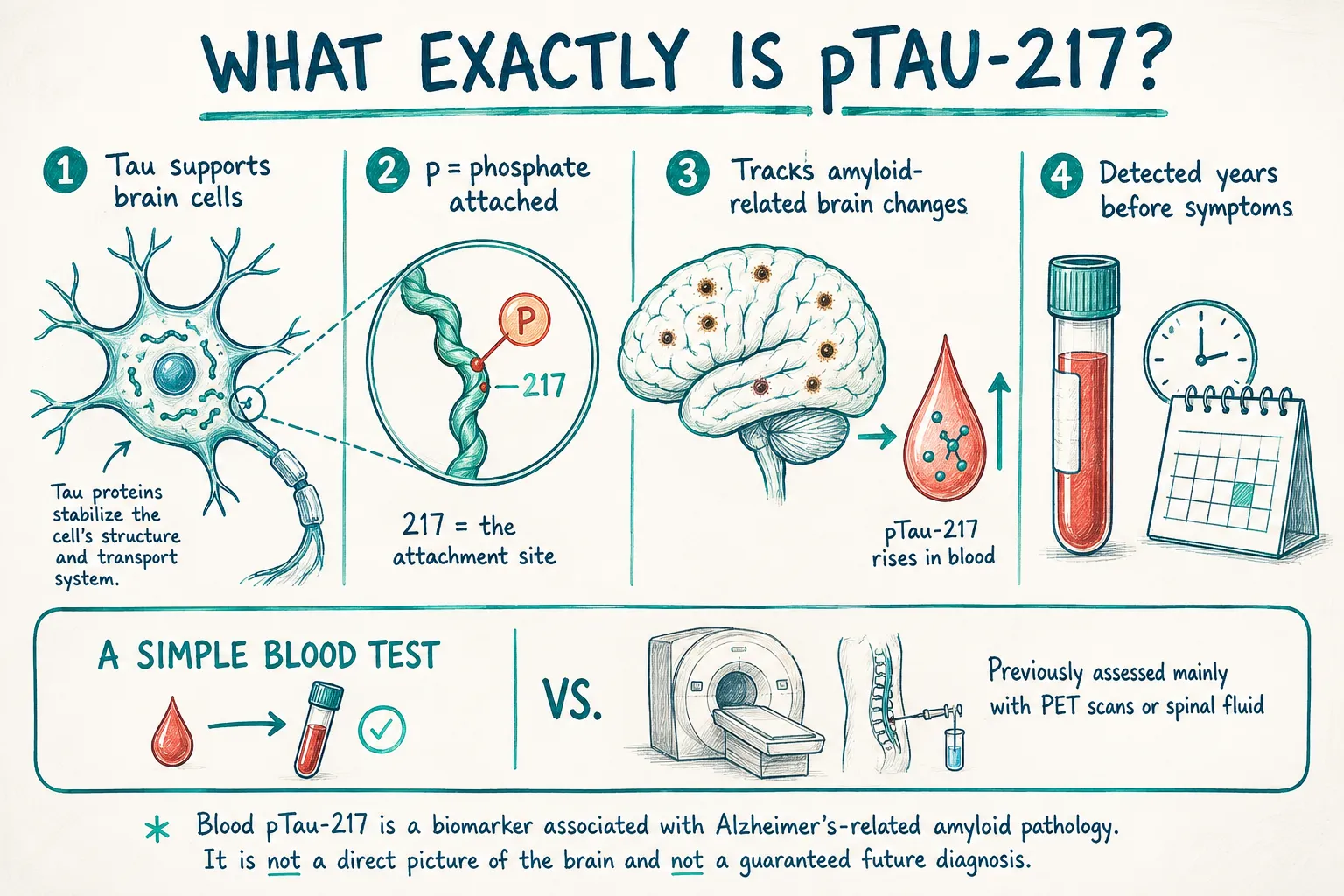
What is pTau-217?
Tau is a protein found inside brain cells. In Alzheimer's disease, tau undergoes abnormal changes and can eventually form tangles that interfere with how those cells work.
The "p" stands for phosphorylated, meaning a phosphate group has attached to the tau protein. The number 217 points to the precise location where that change happened.
When Alzheimer's-related biology begins developing in the brain, levels of pTau-217 in the blood tend to rise. And although the name refers to tau, blood pTau-217 is especially good at tracking the buildup of amyloid plaques, another hallmark of Alzheimer's. Until recently, that kind of information generally required an expensive PET scan or a spinal tap.
Why pTau-217 matters for early detection
Alzheimer's-related brain changes can begin 15 to 20 years before memory problems show up, and pTau-217 may become abnormal during this preclinical period. That makes it one of the most promising tools we have for identifying Alzheimer's-related pathology before symptoms start, which is exactly when there is the most time to act.
Does an elevated pTau-217 result mean I have Alzheimer's?
No. An elevated pTau-217 result is a signal, not a diagnosis.
It suggests that Alzheimer's-related biological changes may be present and that your risk of developing cognitive symptoms is higher. It cannot tell you with certainty whether you will develop symptoms, or when. A negative result is reassuring, but it does not guarantee you will never develop Alzheimer's. It points to a lower likelihood of significant Alzheimer's-related pathology at the time you were tested.
This distinction between detection and prediction sits at the center of the current debate.
What the JAMA study actually found
In July, a JAMA study of nearly 2,700 cognitively healthy older adults found that higher pTau-217 levels were associated with faster cognitive decline and a greater chance of developing cognitive impairment. Among participants with very high levels, researchers estimated a 38% risk of cognitive impairment within five years and a 78% risk within ten years.
Those numbers understandably drew attention. But they were group-level estimates from selected research cohorts whose average age was about 70, and the researchers cautioned that the ten-year figure rested on a relatively small number of people followed for that long. It is meaningful information. It is not a personalized countdown.
Are all Alzheimer's blood tests the same?
Not quite. Several are now available, and each gives a slightly different view of Alzheimer's-related biology. Some measure pTau-217 alone, others combine it with additional markers, and each laboratory method comes with its own reference ranges and cutoffs. That makes the specific test an important part of understanding the result.
The first Alzheimer's blood test cleared by the FDA, in May 2025, measures the ratio of pTau-217 to an amyloid marker. Later that year the FDA cleared Elecsys pTau181, designed mainly to help rule out Alzheimer's-related pathology. In August 2026 it cleared PrecivityAD2, which combines several amyloid and tau measurements, followed by the newly cleared Elecsys pTau217, which measures pTau-217 alone.
These FDA clearances apply to tests used as part of a broader clinical evaluation for people who are experiencing cognitive concerns. The results are meant to be read alongside symptoms, cognitive testing, health history and other clinical information.
BetterBrain uses Quest's AD-Detect pTau-217 test, a laboratory-developed assay that uses different technology from both the newly cleared Elecsys test and the ALZpath test used in many published studies. Because each platform measures pTau-217 differently, each result is interpreted using the reference range established for that specific assay. We use the reference range provided by Quest, then interpret the result alongside cognitive testing, kidney function, other biomarkers, health history and lifestyle.
What a pTau-217 result does not tell you
Here is the part of the conversation that often gets missed. We agree with The New York Times that handing someone a frightening result without enough support can cause real distress. That does not mean the test cannot provide useful information. It means the information needs a fuller picture around it.
A pTau-217 result tells us about one part of Alzheimer's biology. It does not tell us why one person with elevated pathology develops symptoms while another stays cognitively healthy for years, and it says nothing about the many other factors shaping that person's brain health.
Those other factors carry real weight. The 2024 Lancet Commission estimated that addressing 14 modifiable risk factors across life could potentially prevent or delay around 45% of dementia cases at the population level. The U.S. POINTER randomized trial found that a program combining exercise, nutrition, cognitive and social activity, and regular health monitoring improved cognition in older adults at elevated risk. And a long-term observational study found that a healthier midlife lifestyle was associated with a lower incidence of cognitive impairment across pTau-217 levels and APOE4 status. Pathology is not the whole story. The real answers come from looking at all of your numbers together.
What should you do with a pTau-217 result?
Unlike LDL cholesterol or blood pressure, pTau-217 is not a marker you improve through one clearly established intervention. It is primarily a measurement tool.
If your level is elevated, the next step is to understand the complete picture. That may include further clinical evaluation, establishing a cognitive baseline, considering confirmatory testing, assessing eligibility for clinical trials or approved treatments when appropriate, and addressing the modifiable factors that contribute to overall dementia risk. Research into using pTau-217 to monitor treatment response is promising, though there is still a lot to learn about this relatively new test.
Why BetterBrain never offers pTau-217 alone
When we started BetterBrain, we were driven by personal experiences with Alzheimer's in our own families. We learned firsthand that brain health is not about one marker or one intervention. So we do not simply order a pTau-217 test and email you the result. We think that would be irresponsible.
We pair pTau-217 with more than 50 other brain-relevant biomarkers in our Essentials Panel, a cognitive assessment and a detailed look at your health history and lifestyle. We look under the hood for modifiable risk drivers across vascular, metabolic, inflammatory, hormonal and nutritional health. A trained clinical expert then walks you through the findings, explains what they do and do not mean, and builds a personalized action plan focused on the areas where you have the most opportunity to improve. If a result calls for more evaluation, we help you identify the right clinical next step alongside your existing doctor.
The real power does not come from one blood test. It comes from combining early detection with a much broader understanding of your biology, then turning that into meaningful action. Knowledge can be powerful, but only when you know what to do with it.
Learn about pTau-217 testing with BetterBrain, or start your brain health journey to see the full picture.
Frequently asked questions
What is pTau-217?
pTau-217 is a form of the tau protein, measurable in blood, that tends to rise as Alzheimer's-related biology develops in the brain. It is particularly good at tracking amyloid plaque buildup, a hallmark of Alzheimer's disease.
Does an elevated pTau-217 result mean I have Alzheimer's?
No. An elevated result suggests Alzheimer's-related changes may be present and that risk is higher, but it is a signal, not a diagnosis. It cannot confirm whether or when someone will develop symptoms.
Are all Alzheimer's blood tests the same?
No. Some measure pTau-217 alone and others combine it with additional markers, and each laboratory method has its own reference ranges. The specific test used is an important part of interpreting the result.
Can you lower your pTau-217?
pTau-217 is not a marker you improve through one established intervention the way you might lower LDL cholesterol. It is primarily a measurement tool. The action lives in the modifiable risk factors around it, such as vascular, metabolic and lifestyle health.
Who should consider pTau-217 testing?
It is often considered by people who want early insight into Alzheimer's-related risk, including those with a family history. It is most useful when the result is interpreted alongside cognitive testing, other biomarkers, health history and lifestyle, not in isolation.
How much does pTau-217 testing cost with BetterBrain?
The pTau-217 test is $299, offered as an add-on to a Blueprint assessment. It isn't sold on its own, and insurance doesn't cover it. See the full breakdown, including where it's available, on our pTau-217 cost page.

References
News coverage
- FDA clears new Alzheimer's blood test — CNN, Aug 24, 2026
- The breakthrough blood test for Alzheimer's — Eric Topol, Ground Truths (Apr 2025)
- The rise of Alzheimer's blood tests — Nature (2025)
Studies
- pTau-217 and cognitive risk in healthy older adults — JAMA (Jul 2025)
- ALZpath pTau-217 assay study — JAMA Neurology
- Midlife lifestyle and cognitive impairment across pTau-217 / APOE4 — PMC
- 2024 Lancet Commission on dementia prevention
- U.S. POINTER randomized trial results — Alzheimer's Association
FDA clearances & tests
- FDA clears first blood test for diagnosing Alzheimer's (May 2025)
- Elecsys pTau181 — Roche
- PrecivityAD2 — C2N Diagnostics (Aug 2026)
- Elecsys pTau217 — Roche (2026)
- Quest AD-Detect pTau-217 test
BetterBrain CTAs