

Key takeaways:
Strength Training and Brain Health: What 6 Months of Lifting Does to Your Hippocampus
Aerobic exercise gets most of the brain-health attention. The cardiovascular benefits are well-documented, the GPLD1 pathway connecting movement to blood-brain barrier repair is real, and almost every brain health protocol recommends it.
But a body of research has been quietly building on a different type of exercise entirely. And a comprehensive 2025 network meta-analysis just made the case for strength training impossible to ignore.
What the research found
The analysis, published in Frontiers in Aging Neuroscience, pulled data from dozens of randomized controlled trials involving cognitively healthy older adults. When researchers compared aerobic exercise, resistance training, mind-body practices like yoga, and combined programs for their effect on cognitive function, resistance training produced the strongest overall effect on global cognition. The effect size was considered moderate to large in cognitive research, where meaningful improvements are notoriously difficult to achieve.
A parallel 2025 systematic review went further. It examined actual brain imaging alongside cognitive testing. The findings: at least two resistance training sessions per week, sustained for at least six months, were associated with measurable increases in cortical thickness in two critical brain regions.
The hippocampus, your brain's primary memory formation center. And the prefrontal cortex, involved in planning, complex reasoning, and self-control. These are precisely the regions most vulnerable to aging and most associated with early cognitive decline.
These weren't just improvements in test scores. These were structural changes in brain tissue, visible on MRI scans. Six months of consistent strength training literally changed the physical structure of participants' brains.
How it works
The mechanisms connecting resistance training to brain health are distinct from aerobic exercise benefits, which is exactly why both matter.
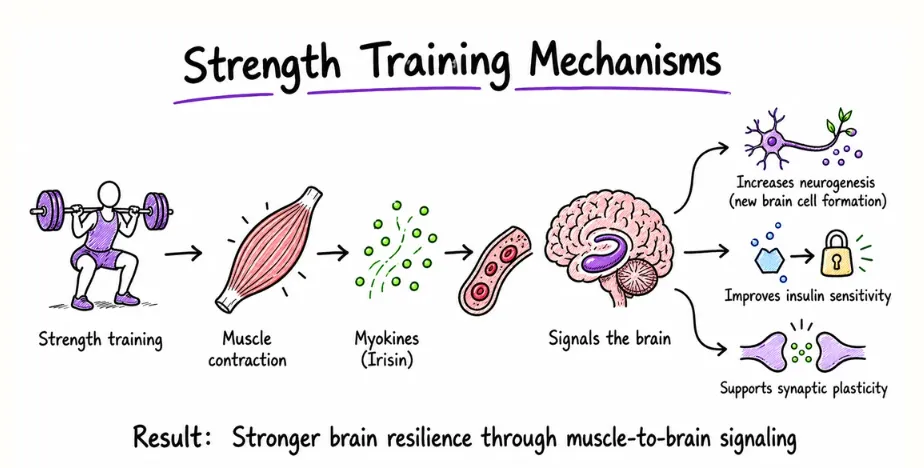
When your skeletal muscles contract under load, they secrete signaling proteins called myokines into your bloodstream. One well-studied myokine, irisin, crosses the blood-brain barrier and has been shown to increase new brain cell formation and reduce neuroinflammation in research models.
Resistance training also improves insulin sensitivity in your muscles, contributing to better metabolic health throughout your body. Given that brain insulin resistance is increasingly understood as a central mechanism in Alzheimer's disease, this metabolic pathway from strength training to brain protection isn't minor.
The exact dose the research supports
Frequency: At least two sessions per week. Some studies suggest three sessions produce greater effects, following a dose-response pattern.
Duration: Six months minimum for structural brain changes to appear on imaging. This isn't a quick fix. It's a sustained practice.
Intensity: Moderate intensity works best, approximately 50 to 70 percent of your maximum. In practical terms, this means lifting a weight you can complete 8 to 12 controlled repetitions with, where the final 2 to 3 reps require genuine effort.
Going through the motions with very light resistance doesn't appear to produce the same stimulus. The dose matters as much as the activity itself.
You don't need a gym membership to start. Bodyweight exercises (squats, push-ups, lunges), resistance bands, or even filled water bottles work. The goal is progressive challenge over time, gradually increasing difficulty as you get stronger.
Tracking whether it's working
Several markers respond to consistent strength training and give you objective evidence the work is paying off.
Insulin sensitivity: Resistance training improves how your cells respond to insulin. You can track this through fasting insulin and HbA1c, which shows your average blood sugar control over three months. Better insulin sensitivity is associated with better cognitive function.
Inflammatory markers: Consistent strength training reduces systemic inflammation. hs-CRP and homocysteine levels respond, giving objective evidence of the anti-inflammatory effect.
Metabolic health markers: Strength training improves multiple metabolic markers including glucose control, lipid profiles like VLDL-C, and overall metabolic function. These improvements happen through muscle-mediated pathways that complement what aerobic exercise does.
Seeing these numbers move is concrete evidence that the effort is producing real change.
The case for combining aerobic and resistance training
Aerobic exercise works through the GPLD1 pathway, where your liver releases protective signals during movement that repair your blood-brain barrier.
Strength training works through entirely different pathways: muscle-derived signaling proteins, improved insulin sensitivity, and hormonal changes that protect brain structure.
These are complementary, not redundant. Research on combined programs shows that doing both produces greater cognitive benefit than either alone. If you're already doing aerobic exercise regularly, adding just two strength sessions per week hits the research-backed minimum.
If you're curious where your insulin sensitivity, inflammation, and metabolic markers stand, BetterBrain's Blueprint testing covers all of them in a single panel, plus 40 more brain health markers.
.webp)