

Key takeaways:
This week, we're exploring stress and brain health: what chronic stress does to your hippocampus (your brain's memory center), how mindfulness and other stress management techniques reverse that damage with measurable structural changes, and what an effective practice actually looks like.
From mechanisms to practical starting points, here's why managing stress isn't just about quality of life, it's about protecting your cognitive future.
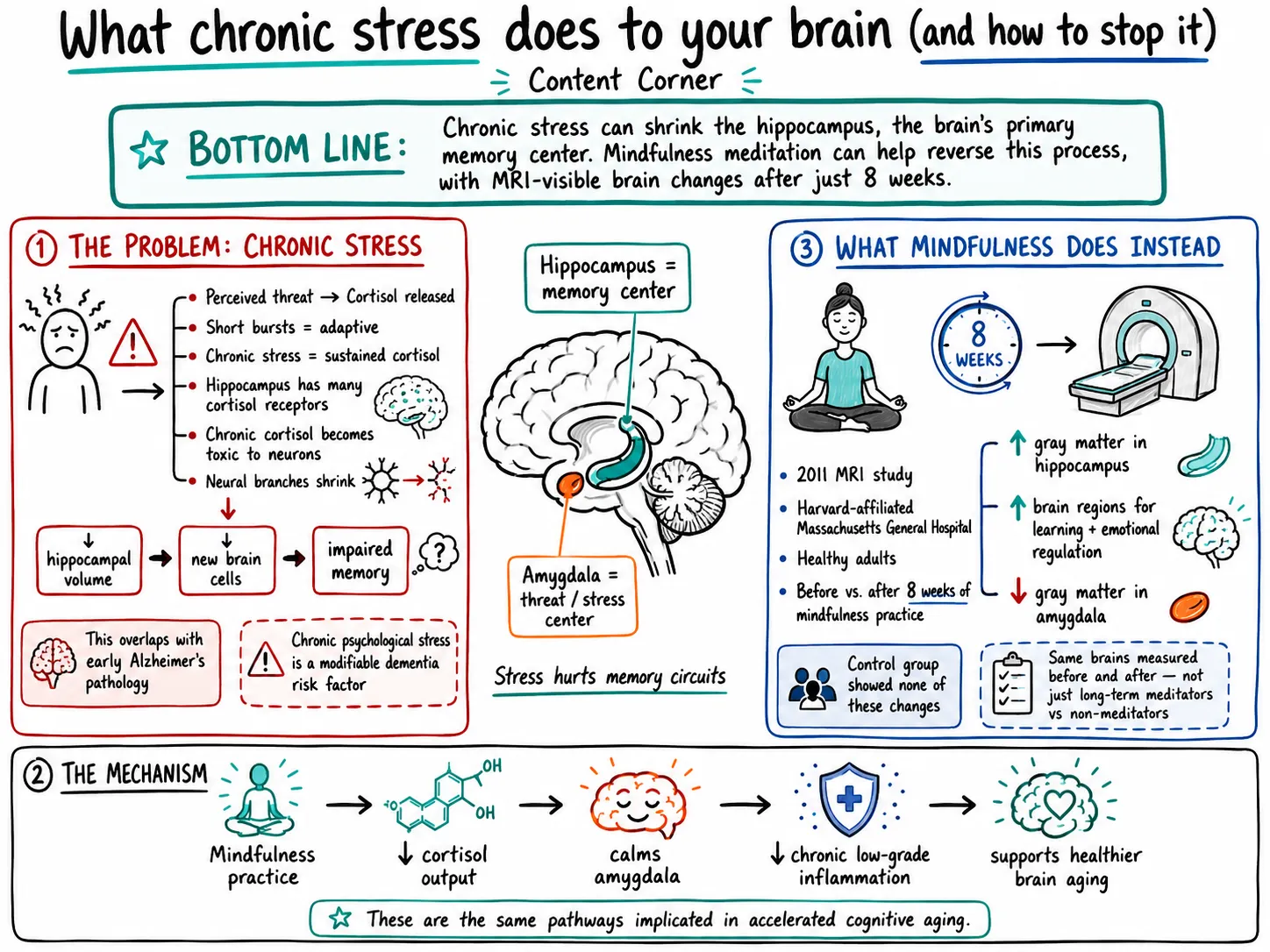
Bottom line: Chronic stress doesn't just feel bad, it physically shrinks your hippocampus, the brain's primary memory center. Mindfulness meditation reverses this process, with structural brain changes visible on MRI after just 8 weeks.
Stress is easy to dismiss as a quality-of-life issue rather than a brain health issue. But the neuroscience tells a different story.
The problem: When your brain perceives a threat, it releases cortisol. In short bursts, this is adaptive, it helps you respond to challenges. Under chronic stress, sustained cortisol elevation becomes toxic to your neurons, particularly in the hippocampus. Your hippocampus is packed with cortisol receptors. Over time, chronic cortisol exposure causes the neural branches that allow brain cells to communicate to shrink. This leads to measurable hippocampal volume loss, reduced formation of new brain cells, and impaired memory. This process overlaps directly with early Alzheimer's pathology. Hippocampal shrinkage is one of the earliest detectable structural changes in Alzheimer's progression, and chronic psychological stress is now recognized as a modifiable dementia risk factor in its own right.
What mindfulness does instead: In 2011, researchers at Harvard-affiliated Massachusetts General Hospital published a landmark neuroimaging study. Using MRI, they measured brain gray matter density before and after 8 weeks of mindfulness practice in healthy adults. Participants showed measurable increases in gray matter in the hippocampus and the brain regions involved in learning and emotional regulation. At the same time, gray matter in the amygdala (the brain's primary stress and threat-detection center) decreased. A control group who didn't practice mindfulness showed none of these changes. This wasn't comparing long-term meditators to non-meditators. It was before-and-after imaging of the same brains, across 8 weeks of practice.
The mechanism: Mindfulness practice reduces cortisol output, calms the amygdala's threat response, and reduces chronic low-grade inflammation associated with sustained stress. These are the same pathways implicated in accelerated cognitive aging.
Technique Spotlight
What this looks like in practice
The science: Stress management works through overlapping biological pathways: reducing cortisol output, calming your nervous system's threat response, and lowering systemic inflammation. Different techniques access these pathways in different ways, which means you have options.
Getting started with the Essential interventions:
- Slow and deep breathing (Essential): Controlled breathing activates your parasympathetic nervous system, your body's "rest and digest" mode. Even a few minutes measurably reduces cortisol and heart rate. Often the easiest entry point.
- Mindfulness meditation (Essential): The technique behind the brain imaging study above. Consistent practice, even 8 to 10 minutes daily, produces measurable effects on stress hormones and self-reported stress within a few weeks.
- Nature exposure (Essential): Time in natural environments reduces cortisol, lowers blood pressure, and improves mood. The effect is dose-dependent.
- Social support (Essential): Strong social connections buffer against stress-related brain damage.
What 10 minutes of mindfulness looks like: Find a quiet spot and sit comfortably. Bring your attention to the physical sensation of your breath, the air moving in and out. Your mind will wander, that's not failure, that's the exercise. Each time you notice it drifting and bring it back, you're doing the rep that builds the skill. There's no perfect posture and no requirement to empty your mind. Just ten minutes of practicing the return.
BetterBrain Tip: Don't overthink which technique to start with. If sitting meditation feels like a stretch, start with a few minutes of slow breathing or a walk outside. The research is clear on this point: the technique that protects your brain is the one you'll actually do.
Featured Biomarker
Tracking stress and its effects
You can't feel your inflammation dropping, but you can measure it. Chronic stress shows up in your bloodwork as elevated hs-CRP, one of the same inflammatory markers associated with cognitive decline. When your stress management practice starts working, that number moves, and BetterBrain's lab panels let you watch it happen.
The effects ripple outward from there. Sleep quality typically improves within weeks of consistent practice, and better sleep gives your glymphatic system (your brain's overnight waste-clearance crew) more time to do its job.
This is what makes stress management such a high-leverage intervention. It never works alone: better stress regulation improves your sleep, better sleep amplifies the benefits of exercise, and lower inflammation makes anti-inflammatory nutrition work harder. Pull one lever and the whole system responds.
BetterBrain Tip: If you're working with a Brain Health Coach, the De-Stress section of your protocol is a natural starting point.
Ready to build a personalized stress management practice? Check if your insurance covers coaching.
Know someone who might benefit from BetterBrain?
Share this referral link and they'll get Essentials labs (50+ biomarkers) for just $39 (normally $89), plus access to $0 coaching with insurance.
.webp)