

Key takeaways:
Understanding APOE4 Genetics
How APOE4 carriers benefit most from specific interventions
Bottom Line: APOE4 is a significant genetic risk factor for Alzheimer's, but it's not deterministic. We've talked before about how environmental and lifestyle factors play a vital role in whether you develop the disease, and certain interventions are particularly beneficial for APOE4 carriers, and today we'll dive in deeper.
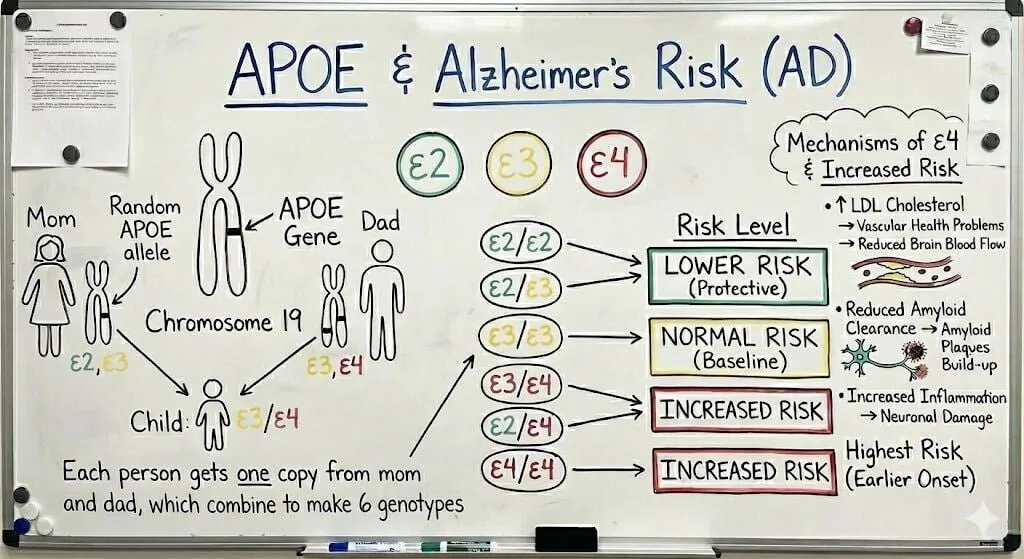
How APOE genetics work: The APOE gene has three major variants: E2, E3, and E4. Each person inherits one copy from their mother and one from their father, creating six possible genotype combinations.
The risk breakdown:
- E2/E2 or E2/E3: Lower risk (protective effect)
- E3/E3: Normal risk (baseline, this is the most common genotype)
- E2/E4 or E3/E4: Increased risk
- E4/E4: Increased risk (highest risk, earlier potential onset)
What E4 does: The E4 variant is associated with several mechanisms that increase Alzheimer's risk:
- Impairs lipid cholesterol metabolism and transport
- Reduces amyloid-beta clearance, leading to plaque buildup
- Increases inflammation leading to neuronal damage
- Causes blood-brain barrier dysfunction and vascular inflammation
Why knowing matters: the prevention advantage: Recent groundbreaking research shows that APOE4 carriers benefit even more from specific interventions than non-carriers.
A 2025 study published in Nature followed over 5,700 people for 34 years and found that closely following the Mediterranean diet lowered dementia risk by at least 35% in people with two copies of the APOE4 gene, the highest risk group.
"Not only did following a baseline Mediterranean diet reduce the probability of developing dementia by 35% in people with two APOE4 genes, but higher adherence to the diet further reduced their risk," said lead author Yuxi Liu, a research fellow at Brigham and Women's Hospital and Harvard Medical School.
The building blocks matter more than the diet label. While this study focused on the Mediterranean diet, it's important to understand our approach at BetterBrain. Following a specific diet like Mediterranean, MIND, or Paleo is less critical than understanding the underlying building blocks.
The totality of research highlights these essential components: healthy fats (especially omega-3s), micronutrients, antioxidants, sufficient protein, and fiber. Diets like Mediterranean are selectively valuable because they're rich in these protective building blocks, but you don't need to follow one specific diet perfectly. What matters most is consistently incorporating these brain-protective nutrients in a way that fits your lifestyle.
Other interventions particularly beneficial for APOE4 carriers:
- Omega-3 supplementation: APOE4 carriers have impaired brain lipid transport and DHA uptake, making higher doses of omega-3s especially important (more on this below in Coach's Corner)
- Aerobic exercise: Particularly effective for APOE4 carriers in maintaining brain volume and cognitive function
- Sleep optimization: Critical for amyloid clearance, which is already impaired in APOE4 carriers
- Lipid management: Monitoring and optimizing ApoB, LDL, and inflammation markers is especially important
- Avoiding head trauma: APOE4 carriers have worse outcomes from traumatic brain injury
- Limiting alcohol: Alcohol is particularly harmful for APOE4 carriers
The empowering reality: As Dr. Richard Isaacson, director of research at the Institute for Neurodegenerative Diseases, notes: "Genes do not have to be your destiny. If the risk of dementia in a person in the highest risk category can be cut by 35% just by following a specific diet, imagine what can be done when you work on dozens of modifiable risk factors such as exercise, sleep, stress and the like."
BetterBrain's APOE testing: APOE testing can be added on to all of our BetterBrain programs. It's a very personal choice, but many people find it very useful and empowering to know. Understanding your status allows us to tailor your prevention protocol with precision, emphasizing the interventions that will have the greatest impact for your specific genetic profile.
Coach's Corner
Omega-3 DHA, Brain-Healthy Salmon & Holiday Mindset
We're very excited to feature Erika Schwan, one of our newest additions to the BetterBrain coaching team, in our Coach's Corner this week!
About Erika: Erika Schwan, RDN, is a registered dietitian nutritionist, health coach, and trained chef with more than a decade of experience in clinical care, functional nutrition, and personalized wellness. Her work centers on individualized nutrition, mindful lifestyle practices, and evidence-informed approaches that support long-term brain health and overall well-being.
Erika's passion for optimizing brain health and advancing dementia prevention is deeply rooted in her personal experience caring for her mother, who lived with Alzheimer's disease.
Personal brain health technique: "For anyone wanting to improve their cognition, support their mental health, and reduce dementia risk, omega-3 polyunsaturated fats are crucial, especially the DHA form found in fatty fish like salmon."
Why DHA matters: DHA is an integral component of neuronal membrane structure. It increases membrane fluidity, supporting neuronal function, neuronal speed, and synaptic transmission. It also reduces neuroinflammation and protects against neurodegeneration.
The APOE4 connection: If you're an APOE4 carrier, getting this essential nutrient at higher than standard doses is even more important. Brain lipid transport and DHA uptake are impaired in APOE4 carriers, meaning you need more to achieve the same brain benefits.
Erika's omega-3 protocol: "I've taken a quality fish oil for years but recently switched to one with more concentrated DHA for increased neuroprotection. I also have a few go-to salmon recipes to ensure a steady intake of omega-3s about 2-3 times per week."
Air Fryer Salmon with Honey-Ginger Marinade
Below is one of my favorite recipes for cold weather. It's tasty, warming, and has additional anti-inflammatory support from fresh ginger. It pairs wonderfully with brown rice (or any whole grain), kimchi, and any vegetables really! I prefer roasted organic broccoli with extra virgin olive oil, a little kosher salt, fresh black pepper, and red pepper flakes for some heat.
If you haven't tried air frying salmon, I highly recommend it!
Ingredients:
- 2, 6-oz salmon filets (skin on or off, per preference)
- 1 Tbsp avocado oil
- 2 Tbsp soy sauce
- 1 Tbsp honey
- 1-inch piece of ginger, grated
- ½-1 tsp garlic, minced (to preference)
Instructions:
- Select "Fish" setting on the air fryer (or select 370°F, 15 minutes); preheat the air fryer for 5 of those minutes
- In a small bowl, whisk the avocado oil, soy sauce & honey together
- Add the ginger & garlic, whisk again
- Cut your salmon into ~1" cubes
- Place salmon & marinade in a sealable container & shake to coat
- Marinate the salmon for 20-60 minutes
- For easier cleanup, place a piece of parchment paper in the bottom of the air fryer taking care not to have the paper exceed the height of the air fryer basket
- Place your marinated salmon in the air fryer basket and cook for 10 minutes at 370°F; check for doneness
- Enjoy!
Making Space for Mental Health
"As I've moved into the holiday season, I'm aware of both the joys and stresses that can arise at this time. As someone who's lost loved ones around the holidays, I'm learning the importance of making space for mental health.
Our mental and emotional health is intricately tied to brain health and impacts so many areas of our lives like stress, sleep, appetite and motivation.
Making space for mental and emotional health can take many forms. First and foremost, working with a licensed mental health professional can be incredibly supportive and transformative. Define your support system and lean upon them at this time.
I find using an app for gratitude practice trains my brain to continue to see the good things in my life and is an easy way to reflect on what I've logged. Finding ways to ground myself in breath and nature are healing measures: a simple home yoga practice, app-guided meditations, a walk at the park, or a hike in the woods and mountains.
And finally, practicing self-compassion as we navigate the nuance of this season can help us walk with a lighter step. Wishing you and yours all the best this holiday season!"
.webp)