

Key takeaways:
One shot to lower cholesterol for life: what PCSK9 gene editing means for your brain
The short version: In the Heart-2 trial, a single infusion of a gene editing therapy called VERVE-102 lowered LDL cholesterol by up to 62% and kept it down for as long as 18 months. It is a phase 1b result in 35 people with inherited high cholesterol, so it is years away from a pharmacy. The part that matters to you now is the target. High LDL in midlife is one of the 14 modifiable dementia risk factors named by the Lancet Commission, and the particle count underneath it, ApoB, is something you can measure this month.
Most people learn their cholesterol is high at an annual physical, get told to watch it, and never find out what the number is actually doing. It is doing something to your brain.
That connection is why a cardiology result got our attention. In May 2026, researchers reported that a single infusion of a gene editing medicine lowered LDL cholesterol substantially, and that the reduction held for up to 18 months. The results were presented at the European Atherosclerosis Society Congress and published in the New England Journal of Medicine.
It is early research in a small, specific group of patients. But the biology it targets is among the most studied in all of cardiovascular medicine, and it runs straight to your brain.
What VERVE-102 actually did
Heart-2 is a phase 1b trial. The interim analysis covered 35 participants, average age 52, all with heterozygous familial hypercholesterolemia, premature coronary artery disease, or both, and all already on the maximum statin dose they could tolerate.
Each received one infusion, at doses from 0.3 to 1.0 mg/kg. The results, per Lilly's May 25, 2026 release:
- PCSK9 protein fell by 51% to 88%, depending on dose.
- LDL cholesterol fell by 9% to 62%. At the highest dose, the drop was 62%, or 78 mg/dL in absolute terms.
- Reductions were sustained, with durability observed for up to 18 months after a single treatment.
- There were no dose-limiting toxicities and no treatment-related serious adverse events. Side effects were mostly low-grade infusion reactions and fatigue. All 35 participants received their full dose and none withdrew.
One infusion. Effects still holding a year and a half later.
How PCSK9 works, in plain language
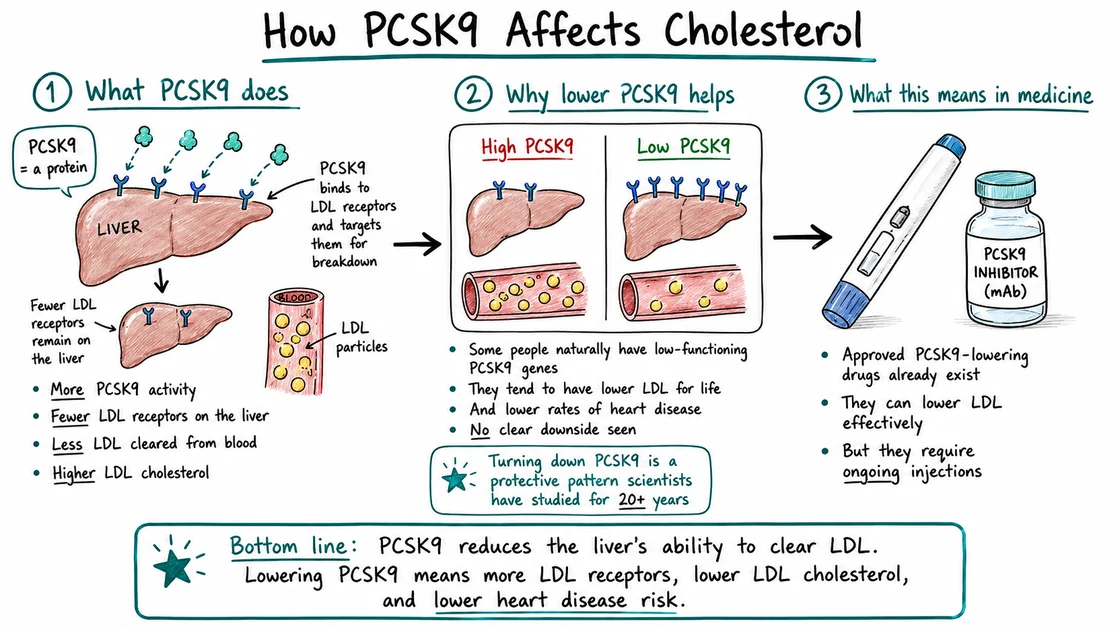
Your liver clears LDL cholesterol out of your blood using surface proteins called LDL receptors. Think of them as docking ports: the more ports available, the more LDL particles get pulled out of circulation.
PCSK9 is a protein that destroys those ports. More PCSK9 activity means fewer receptors, which means more LDL staying in your bloodstream.
Here is the part that makes this target unusually well understood. Some people are born with naturally low-functioning PCSK9 genes. They have markedly lower LDL across their entire lives and substantially lower rates of heart disease, with no apparent downside. Turning PCSK9 down is not a theory. It is a protective pattern that already exists in nature and has been studied for two decades.
Drugs that lower PCSK9 have been approved for years. What is new here is the delivery. VERVE-102 uses base editing, a precise form of gene editing, to make a single change to the PCSK9 gene inside liver cells. The goal is to do once, permanently, what existing drugs do by repeated injection.
The honest caveats
This headline is easy to over-read. The careful version:
It is a phase 1b trial. That stage is designed mainly to test safety and look for early signals in a small number of people. It has not been shown to prevent heart attacks, strokes, or cognitive decline. A phase 2 trial is the next step, with enrollment planned by the end of 2026.
It is a specific patient group. Everyone enrolled had an inherited form of very high cholesterol or early coronary artery disease and needed aggressive LDL lowering despite maximum oral therapy. These are not general-population results.
Gene editing is a young field. The PCSK9 mechanism is exceptionally well characterized, which is reassuring. Making a permanent edit to a gene is still new, and the long-term safety record takes years to build. Approval, if it comes, will likely start with very high-risk patients such as those with familial hypercholesterolemia, and the price is likely to be high.
It is years away. Nobody should be adjusting their plan today on the expectation that this arrives soon.
Why cholesterol is a brain story, not only a heart story
Brain health is whole-body health, and few things connect the two as directly as lipids.
ApoB is the number underneath LDL
You have probably heard of LDL cholesterol. ApoB is the more precise measurement sitting beneath it.
Every LDL particle carries exactly one ApoB protein. So LDL-C tells you how much cholesterol is being carried inside LDL particles, while ApoB tells you how many particles there actually are. Since it is the particles that lodge in artery walls and start plaque, ApoB is the better predictor of risk. When the two numbers disagree, ApoB is the one to trust.
Among BetterBrain clients, 86% come back with a suboptimal ApoB. It is the single most commonly out-of-range marker we see, and most people have never had it measured.
The Lancet Commission added LDL to the dementia list in 2024
The blood vessels feeding your brain are subject to the same lipid-driven damage as the ones feeding your heart, and that vascular damage is one of the major pathways of cognitive decline.
This is no longer a fringe position. In its 2024 update, the Lancet Commission on dementia prevention added high midlife LDL cholesterol as one of 14 modifiable risk factors, based on cohort studies covering more than a million participants plus a Mendelian randomization meta-analysis of 27 studies. The Commission attributes 7% of preventable dementia to high LDL alone, and links nearly half of dementia cases to the 14 factors combined.
High cholesterol in your forties and fifties is now formally a brain risk factor, not only a heart one.
If you carry APOE4
People who carry an APOE4 variant tend to run higher LDL, and APOE4 is the strongest common genetic risk factor for Alzheimer's disease. That combination is one reason lipid management is a core part of what we do, and one reason knowing your genotype can change what you prioritize rather than just giving you something to worry about.
The bigger picture
Between therapies like this one and the medications already on the shelf, the tools for managing cardiovascular disease are getting very good, and they will keep improving. But adding years to your life is only worth so much if your brain is not working well for those years. That is the conversation most people are not having yet, and it is the one that matters most to us.
What this means for you, right now
You do not have to wait for a therapy that is years away. The target itself, your lipid health, is measurable and movable today.
- Get ApoB tested, not just standard cholesterol. A routine lipid panel gives you total cholesterol, LDL, HDL, and triglycerides. ApoB counts the particles actually driving damage and is rarely ordered unless you ask for it. It is one of the most informative single markers for both heart and brain health.
- Treat lipids as a lifelong number, not a yearly one. The PCSK9 story works precisely because it lowers exposure over decades. Risk accumulates the same way. Small, steady improvements compound in your favor, and starting earlier is worth more than starting perfectly.
- Use the levers you already have. Diet, regular movement, and, where your physician recommends them, proven lipid-lowering medications all work today. Statins and existing PCSK9 inhibitors are not placeholders waiting for gene editing. They are the current standard of care.
- Look at the whole vascular picture. ApoB, Lp(a), triglycerides, blood pressure, and HbA1c interact. One number in isolation rarely tells you what to do first.
ApoB is one of the 50+ biomarkers in the BetterBrain panel, alongside homocysteine, hs-CRP, Lp(a), HbA1c and the rest of the vascular and metabolic markers. See everything we test.
Common questions
Is PCSK9 gene editing available now?
No. VERVE-102 is in phase 1b trials. A phase 2 trial is planned to begin enrolling by the end of 2026, and broad availability is years out. If it is approved, the first patients are likely to be people with familial hypercholesterolemia or other very high-risk conditions.
What is the difference between ApoB and LDL cholesterol?
LDL-C measures the amount of cholesterol carried inside LDL particles. ApoB measures the number of those particles, because each one carries exactly one ApoB protein. Two people can have the same LDL-C with very different particle counts. When the two disagree, ApoB is the better predictor of cardiovascular and cerebrovascular risk.
Does lowering cholesterol reduce dementia risk?
The 2024 Lancet Commission identified high midlife LDL cholesterol as one of 14 modifiable dementia risk factors and attributes 7% of preventable dementia to it. That is an association drawn from large cohort and genetic studies, not proof that lowering LDL prevents dementia in any individual. What is well established is that lipid-driven damage to blood vessels is one of the major pathways of cognitive decline, and that the vessels feeding your brain are affected the same way as the ones feeding your heart.
Should I get an ApoB test?
ApoB is not part of a standard lipid panel and usually has to be requested. It is most informative if you have a family history of early heart disease or dementia, if your LDL and triglycerides do not line up, if you carry an APOE4 variant, or if you simply want a clearer read than total cholesterol gives you. Discuss it with your physician or your Brain Health Coach.
Does BetterBrain test ApoB?
Yes. ApoB is included in the BetterBrain biomarker panel, which covers 50+ markers selected for their connection to brain health, across metabolic, cardiovascular, hormonal, inflammation, and nutrient categories. Blueprint is $89 with insurance and $399 without, and includes a cognitive assessment and an up-to-90-minute session with a Brain Health Coach who turns the results into a personalized action plan.
The bottom line
A one-time gene editing infusion produced large, durable reductions in LDL cholesterol in an early trial, by copying a protective genetic pattern that already exists in nature. It is not available, it is not proven to prevent anything yet, and it will not be in a clinic near you for years.
What is available is the target. Your lipid numbers are one of the few brain risk factors you can measure precisely, act on immediately, and improve over decades. Whatever arrives in five or ten years, the decades in between are the ones you protect now.
.webp)