

Key takeaways:
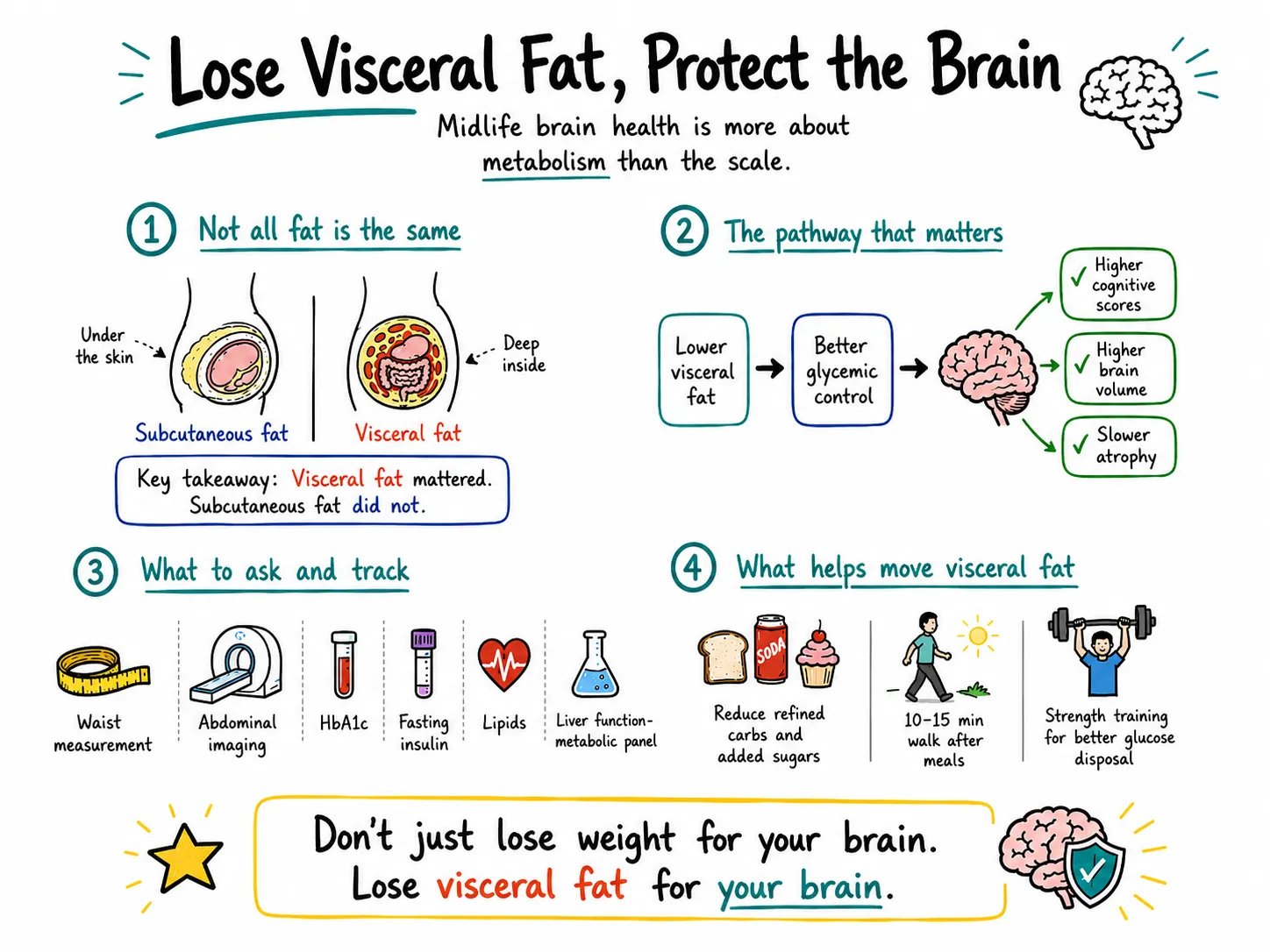
A study just landed in Nature Communications that reframes how to think about midlife weight loss and brain health. Researchers followed 533 adults for up to 16 years after they completed lifestyle interventions, then scanned their brains and tested their cognition. The finding: it wasn't weight loss that predicted slower brain atrophy and better cognitive scores years later. It was sustained loss of visceral fat specifically.
This matters because most people, and most doctors, still track weight on a scale. The number on the scale lumps together fat, muscle, water, and where on the body the fat actually sits. The new data suggests that for brain health, where the fat is matters more than how much of it there is.
What the study found
The research, called the Follow-Interventions-Trials (FIT) project, pulled participants from four earlier 18 to 24 month lifestyle randomized trials. The average age at follow-up was 61. Each participant had abdominal MRI, brain MRI, and Montreal Cognitive Assessment (MoCA) testing 5 to 16 years after their original intervention.
Three findings stood out. Lower long-term visceral fat exposure, calculated across baseline, post-intervention, and follow-up, independently predicted higher cognitive scores. Visceral fat loss during the intervention period predicted higher brain volumes years later, independent of overall weight loss. And among the participants who had three full sets of scans over the years, lower long-term visceral fat was associated with a slower rate of brain atrophy.
The same patterns were not observed for subcutaneous fat, the kind that sits under the skin and shows up on a pinch test. Visceral fat, the deeper fat surrounding the organs, was the variable that mattered.
The proposed mechanism is glycemic. Visceral fat is metabolically active. It secretes inflammatory signals and contributes to insulin resistance. Both of these are increasingly understood as drivers of cognitive decline. When visceral fat goes down, glycemic control improves, and the brain appears to benefit downstream.
Why this changes how we think about midlife weight
Most people who decide to lose weight in their fifties do not distinguish between subcutaneous fat, visceral fat, and muscle. Many lose all three. Losing muscle in midlife is a problem on its own. Losing subcutaneous fat without losing visceral fat is largely cosmetic. Losing visceral fat appears to be the part that actually protects the brain.
This also reframes "skinny fat." A person can have a body mass index in the normal range and still carry significant visceral fat. The scale will not flag this. A waist measurement, a DEXA scan, or abdominal imaging will.
For anyone in their 40s, 50s, or 60s thinking about brain health, the practical question is no longer "should I lose weight." It is "what is my visceral fat doing, and what is actually moving it."
What you can do
Three things tend to move visceral fat without requiring dramatic restriction.
The first is reducing refined carbohydrates and added sugars. Visceral fat is more responsive to insulin signaling than subcutaneous fat. Lowering postprandial glucose spikes is associated with reduced visceral fat over time.
The second is consistent moderate-intensity movement, especially after meals. A 10 to 15 minute walk after eating blunts the post-meal glucose curve. Repeated over months, this contributes meaningfully to visceral fat reduction.
The third is strength training, which we covered last week. Muscle is the primary site of glucose disposal in the body. More muscle means better glycemic control, which means less visceral fat accumulation.
The biomarkers that respond, and the ones we look at first with members, are HbA1c (your average blood sugar over three months), fasting insulin, and the broader metabolic panel that looks at lipids and liver function. These shift before the scale shifts. They tell you whether the metabolic conditions that drive visceral fat are improving.
The bottom line
The next time someone tells you to lose weight for your brain, the more useful version of that advice is to lose visceral fat for your brain. The number on the scale was always a poor proxy for what is happening inside the body. The new research makes that clearer.
If you are already a BetterBrain member, your most recent HbA1c, fasting insulin, and metabolic panel results are in your dashboard. Worth a fresh look in light of this.
If you have not yet started, these markers are part of the BetterBrain Essentials Panel we look at first.
.webp)