

Key takeaways:
Until recently, getting a continuous glucose monitor meant getting a prescription. In March 2024 the FDA cleared the first over-the-counter CGM, and Abbott followed with two more that June, including one designed specifically for people without diabetes.
So now you can buy a sensor and spend a couple of weeks finding out what happens after your morning oatmeal.
The question worth asking is not what the graph shows. It is whether seeing the graph changes what you do.
Key takeaways
- CGMs are available over the counter in the US. You no longer need a prescription or a diagnosis to wear one.
- A sensor measures glucose in the fluid between your cells, and those readings can lag behind blood glucose, especially when levels are moving quickly.
- The most useful thing a CGM does for most people is motivational. Seeing how your glucose responds can give you a reason to follow through on a habit you already knew was worth trying.
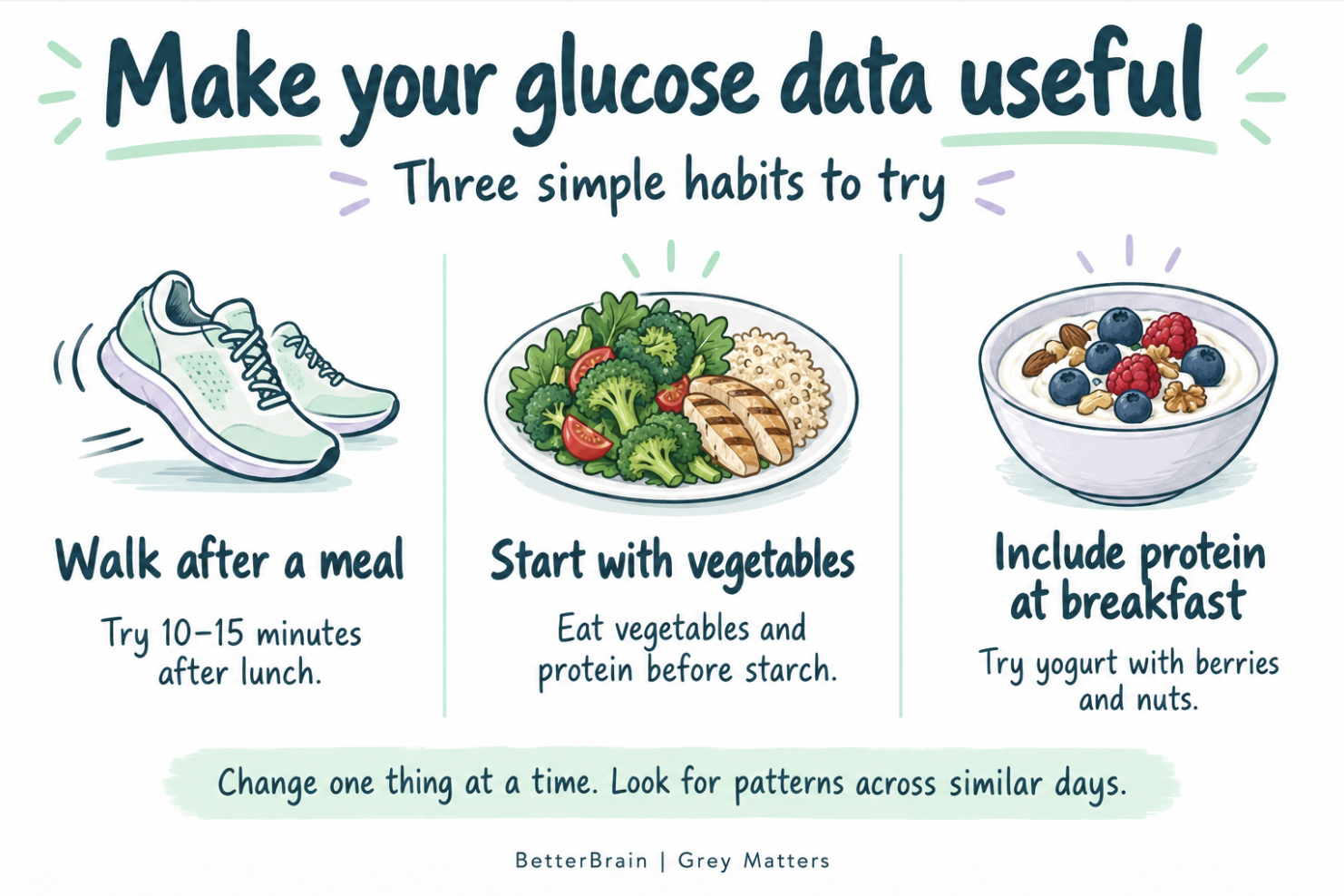
- Three changes are worth testing: a short walk after a meal, eating vegetables and protein before the starch, and adding protein to breakfast.
- Compare similar days, not single readings. Sleep, stress and activity all move the number.
- Higher HbA1c has been associated with faster cognitive decline in observational research. That research did not test CGMs, and wearing a sensor has not been shown to improve memory.
Can you use a continuous glucose monitor without diabetes?
Yes. Since March 2024, when the FDA cleared the first over-the-counter continuous glucose monitor, you can buy a sensor without a prescription. Abbott received clearance for two more that June, one of which is intended for adults who do not have diabetes and want to track their glucose for general health.
For people without diabetes, a CGM is a learning tool rather than a medical one. It is not a diagnostic test, and it is not a substitute for lab work.
What does a CGM actually measure?
A CGM measures glucose in the interstitial fluid, the fluid between your cells, taking readings throughout the day. It is not sampling your blood directly, which is why the readings can lag, especially when your glucose is rising or falling quickly.
What you get is the shape of a meal. How much your glucose rose, how long it stayed elevated, and what happened overnight.
Over several days that turns into more useful questions. Does my usual lunch look different when I walk afterward? Do I see a pattern after late dinners? Does it repeat?
Context matters more than any single number. A hard workout, a stressful afternoon or a poor night's sleep can all move the reading, so comparing similar days is far more informative than reacting to one peak.
Why blood sugar matters for brain health
Blood sugar naturally rises after eating. What deserves attention is glucose that repeatedly rises unusually high or stays elevated for long periods. Over time, persistently high blood sugar can damage blood vessels and nerves, including the circulation that supports brain health.
In the English Longitudinal Study of Ageing, researchers followed 5,189 adults, with an average age of 66, for about eight years. Higher HbA1c was associated with faster cognitive decline. HbA1c reflects average blood glucose over roughly two to three months.
That finding concerns longer-term glucose exposure. It doesn’t show that an occasional spike damages your brain, or that flattening every rise prevents cognitive decline. A CGM can help you notice recurring patterns and explore habits that support glucose management.
We covered more of that connection in an earlier Grey Matters on blood sugar, insulin, and brain health.
Three changes worth testing with a CGM
Start with a question you want to answer rather than a general intention to watch the number. Two to four weeks gives you enough time to observe your usual routine and try a few manageable changes.
Does walking after a meal lower blood sugar?
Short walks after eating have real research behind them. A meta-analysis of seven studies in Sports Medicine found that breaking up prolonged sitting with short light-intensity walking breaks lowered post-meal glucose more than standing breaks did, and both were better than staying seated.
How to test it: compare your usual lunch with and without a ten to fifteen minute walk afterward. Keep the meal, the portion and the timing as similar as you can, and repeat the comparison across several days before you draw a conclusion.
Walking after meals is also one of the habits our coaches keep recommending, which is a reasonable signal that it is both effective and sustainable.
Does the order you eat your food in affect blood sugar?
How to test it: start with the salad or vegetables and the protein portion, then eat the rice, bread or potatoes. Keep the foods and the portions identical so that meal order is the only thing you are changing.
This is one of the approaches in our guide to metabolic health and fasting insulin, and it tends to be the easiest change to keep, because you are not giving anything up.
Does protein at breakfast help?
How to test it: if breakfast is usually toast or cereal on its own, try eggs alongside whole-grain toast, or plain Greek yogurt with berries and nuts. Compare it against your usual breakfast.
Pay attention to how satisfied you feel a couple of hours later, not only to the curve. A glucose reading is one piece of information about a meal. Its fiber, protein, nutrients and how well it holds you until lunch all matter too.
How to run the test so the results mean something
Change one thing at a time. If you swap your breakfast and start walking after lunch in the same week, you will not know which one did what.
Keep short notes on meals, activity, alcohol and sleep. These are the variables most likely to explain a reading that surprises you.
Look for patterns across several comparable days. One high peak after an unusual meal on a bad night's sleep is not a finding.
And be honest about when you have learned what there is to learn. Most people find the same few patterns and then stop getting new information. Once you have found changes you can stick with, it is worth asking whether continued tracking is still helping you.
How long should you wear a CGM?
For most people using one out of curiosity, two to four weeks is enough. That covers a normal routine, a weekend, and enough repetitions of a change to see whether the pattern holds.
If you use a CGM as part of diabetes care, that is a different situation. Follow the monitoring plan you have agreed with your care team.
What a CGM will not tell you
A sensor shows you what happened after a meal. It does not tell you how much insulin your body produced to make that happen, and insulin is often the marker that shifts first.
That is a lab question. Fasting glucose, fasting insulin and HbA1c together give a fuller picture of glucose regulation than any two-week stretch of sensor data, and they are the measurements the long-term research was actually built on.
Technique spotlight: Blood Sugar Management
If you are deciding which changes to try, the Blood Sugar Management technique in BetterBrain's Brain Health Arsenal covers food choices, activity, sleep and medication where appropriate, with guidance on managing insulin resistance and glucose levels.
The guidance is straightforward: higher-fiber and lower-glycemic foods, regular movement, and enough sleep. Stability matters more than eliminating carbohydrates, and you do not need a sensor to begin. But if seeing your own trends helps you follow through, monitoring can be a useful addition.
If you are considering one, the Stelo biosensor and Lingo are both on BetterBrain Picks.
Frequently asked questions
Can you wear a continuous glucose monitor if you don't have diabetes?
Yes. Over-the-counter CGMs have been available in the US since March 2024, and one of them is specifically intended for adults without diabetes. For this group a CGM is a learning tool, not a diagnostic test.
How long should you wear a CGM if you are just curious?
Two to four weeks is generally enough to observe your usual routine and test a few changes. Most people find the same handful of patterns and then stop learning new things from the data.
Does walking after a meal lower blood sugar?
Short walks after eating have been shown to reduce post-meal glucose. A meta-analysis of seven studies in Sports Medicine found that breaking up prolonged sitting with short light-intensity walking breaks lowered post-meal glucose more than standing breaks did.
Does eating vegetables and protein before starch lower blood sugar?
Many people see a gentler rise when they eat vegetables and protein before the starch in a meal. To test it for yourself, keep the foods and portions the same and change only the order, then compare across several similar days.
Can a CGM tell you if you have insulin resistance?
No. A CGM shows how your glucose responds to meals and activity, but it does not measure insulin. Fasting insulin, fasting glucose and HbA1c together give a clearer picture, and those are blood tests rather than sensor readings.
Does using a CGM improve brain health?
There is no trial showing that wearing a CGM improves memory or cognition. What observational research does show is that higher HbA1c is associated with faster cognitive decline. A sensor may help you build habits that support glucose regulation, but the sensor itself has not been shown to change brain outcomes.
The bottom line
A continuous glucose monitor is good at showing you what a meal did and good at making an abstract piece of advice feel concrete. If watching your glucose respond to a post-lunch walk is what finally gets you walking after lunch, the sensor did something useful.
What it cannot do is tell you where your metabolic health sits over months and years. That comes from lab work. Blueprint includes 50+ biomarkers, a consultation of up to 90 minutes with a brain health expert, and a personalized action plan ranked by impact. $89 with insurance, $399 cash pay.
Already a BetterBrain client? View your metabolic markers and talk with your coach about what you would like to test.
.webp)
References
References
- US Food and Drug Administration. FDA clears first over-the-counter continuous glucose monitor. March 2024. https://www.fda.gov/news-events/press-announcements/fda-clears-first-over-counter-continuous-glucose-monitor
- Abbott. Abbott receives US FDA clearance for two new over-the-counter continuous glucose monitoring systems. June 10, 2024. https://abbott.mediaroom.com/2024-06-10-Abbott-Receives-U-S-FDA-Clearance-for-Two-New-Over-the-Counter-Continuous-Glucose-Monitoring-Systems
- Zheng F, et al. HbA1c, diabetes and cognitive decline: the English Longitudinal Study of Ageing. Diabetologia. 2018;61(4):839-848. https://link.springer.com/article/10.1007/s00125-017-4541-7
- Buffey AJ, et al. The acute effects of interrupting prolonged sitting time in adults with standing and light-intensity walking on biomarkers of cardiometabolic health. Sports Medicine. 2022;52(8):1765-1787. https://link.springer.com/article/10.1007/s40279-022-01649-4