
Key takeaways:
Most clients pay $0 with employer sponsored insurance.
How to Personalize Your Brain Health Plan With Your Own Data
Most brain health advice is useful, but it is also designed for the average person.
Sleep more. Move often. Eat a nutritious diet. Manage stress. Build strength.
These fundamentals matter. But they cannot tell you which risk factors deserve the most attention, what may be changing in your body, or whether your current routine is producing the results you want.
Personalized brain health guidance uses your own labs, health history, sleep, activity, habits, and goals to help determine where to focus first.
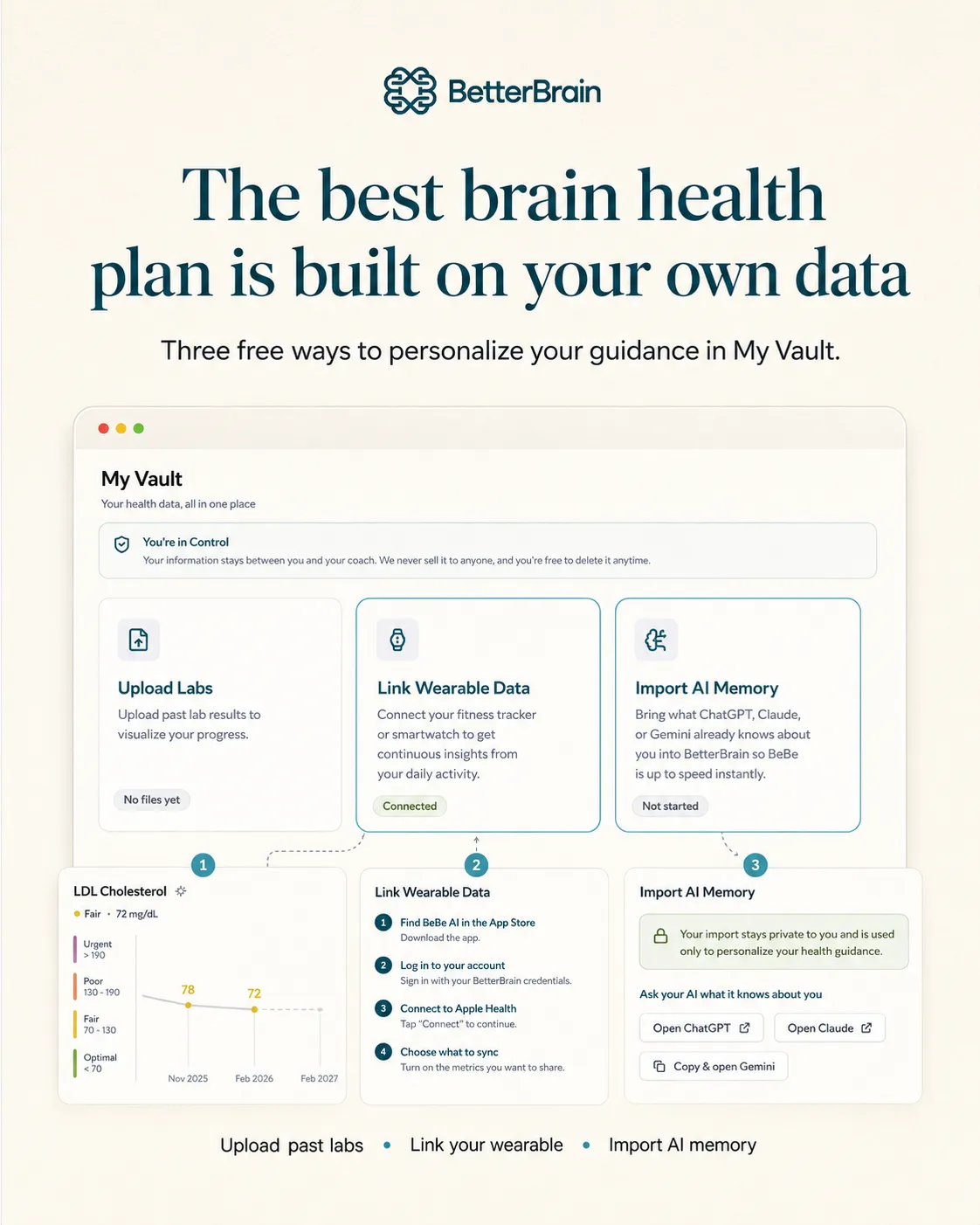
BetterBrain members can now bring more of that information into My Vault, the health data home inside the BetterBrain platform. You can upload previous lab results, connect wearable data, and import relevant health context from an AI assistant such as ChatGPT, Claude, or Gemini.
All three tools are available free across BetterBrain accounts.
Why Does Generic Brain Health Advice Have a Ceiling?
General health advice tells you what tends to help people on average. It cannot tell you which intervention is likely to matter most for you.
Two people can follow the same routine and have very different needs because they begin with different:
- Biomarker levels
- Genetics and family histories
- Sleep patterns
- Activity levels
- Medical histories
- Medications and supplements
- Diets, habits, and goals
One person may need to focus on improving sleep consistency. Another may already sleep well but have an elevated cardiovascular risk marker that deserves more attention. A third may be exercising regularly but not recovering adequately.
That is why personalization matters. It helps turn broad recommendations into clearer priorities.
Research has also found that multidomain brain health interventions tailored to individual risk profiles can produce better cognitive outcomes than general health information alone. You can read the randomized controlled trial published in Nature Medicine here.
What Is Personalized Brain Health Guidance?
Personalized brain health guidance applies current research to information about your own health.
Instead of simply telling everyone that sleep is important, personalized guidance can consider:
- How much you are actually sleeping
- Whether your sleep duration or consistency is changing
- How your sleep relates to your activity and recovery
- Whether your current protocol appears to be helping
- Which other risk factors may deserve attention
Personalization does not replace the fundamentals. It helps identify which fundamentals matter most for you, where to begin, and what to monitor over time.
How Does My Vault Help Personalize Your Brain Health Plan?
My Vault brings several sources of health information together inside your BetterBrain account.
You can use it to:
- Upload previous laboratory results
- Connect sleep and activity data from a wearable
- Import relevant health context from another AI assistant
Together, these tools give BeBe, BetterBrain’s AI brain health coach, a more complete picture of your health and goals.
Upload Past Lab Results and Track Changes Over Time
A single laboratory result is only a snapshot. The trend often provides more useful context.
If you have previous results stored in a patient portal, computer folder, email, or paper file, you can upload them to My Vault as a PDF or image. BetterBrain can extract the biomarker results and display them alongside your current numbers.
Tracking results over time can help you understand:
- Whether a biomarker is moving in the desired direction
- Whether a change is new or part of a longer pattern
- How your results respond to changes in your routine
- Whether an intervention appears to be working
- Which markers may deserve further discussion with your clinician
For example, a cholesterol result may appear acceptable when viewed alone. But seeing several years of results together could reveal that the number has been steadily increasing or improving.
Your brain health plan should respond to what is changing, not just what appeared on one test.
Link Your Wearable Data
Questionnaires capture what you remember. Wearables can capture what is happening each day.
If you use a fitness tracker or smartwatch, you can connect it to BetterBrain through the BeBe app and Apple Health. You choose which information you want to share, and you can change the permissions or disconnect the integration at any time.
Depending on your device and permissions, wearable data may provide useful context about:
- Sleep duration
- Sleep consistency
- Daily movement
- Exercise
- Heart rate
- Recovery patterns
- Changes in routine
This can make guidance more specific.
Instead of receiving another reminder that sleep is important, you may be able to see that your sleep duration is adequate but inconsistent, or that your activity has declined over the past several weeks.
The goal is not to obsess over every daily number. It is to recognize meaningful patterns that may otherwise be easy to miss.
Import Your AI Memory
Many people already use ChatGPT, Claude, or Gemini to discuss their health, routines, goals, and preferences.
You may have already told an AI assistant about:
- Your health history
- Current symptoms or concerns
- Injuries
- Medications and supplements
- Family medical history
- Exercise habits
- Diet
- Sleep
- Health goals
- How you prefer advice to be delivered
- Strategies you have already tried
You can now bring that context into BetterBrain instead of starting from the beginning.
Visit Import AI Memory inside My Vault. You will see a prompt that you can open or paste into the AI assistant you use. The assistant will organize the relevant information it knows about you. You can then review the response and paste it into BetterBrain.
The process takes about a minute.
Once imported, BeBe can begin with more context about your history, preferences, goals, and previous efforts.
How Is BeBe Different From ChatGPT, Claude, or Gemini?
General AI assistants draw from broad knowledge across an enormous range of subjects. Their responses are also largely shaped by what you choose to tell them in each conversation.
BeBe is built specifically for brain health. It is grounded in brain health research that has been reviewed and interpreted by BetterBrain’s scientists and clinicians.
BeBe can then apply that specialized knowledge to information within your BetterBrain account, including:
- Your laboratory history
- Wearable sleep and activity data
- Health profile
- Current brain health protocol
- Uploaded documents
- Coaching insights
- Imported health context
- Personal goals and preferences
The distinction is specialized brain health science combined with your personal data.
A general assistant may repeat common recommendations. BeBe is designed to help you understand how the evidence relates to your own risks, results, and priorities.
Is My Health Information Private?
Your imported information stays private to your account and is used to personalize your guidance.
You control what you upload, what wearable information you share, and whether you want to delete information later. Wearable permissions can also be changed or turned off at any time.
Only import information you are comfortable storing in your BetterBrain account.
How Do I Get Started With My Vault?
You do not need to complete everything at once.
Start with whichever option is easiest:
- Upload one previous lab report.
- Connect your wearable through the BeBe app and Apple Health.
- Import relevant health context from ChatGPT, Claude, or Gemini.
- Review your health profile and current protocol.
- Ask BeBe what patterns or priorities stand out.
All three personalization tools are available with a free Self Directed BetterBrain account.
Members who want to go further can also purchase laboratory testing through Blueprint or enroll in the BetterBrain Coaching Program.
Frequently Asked Questions About Personalized Brain Health Guidance
What is personalized brain health guidance?
Personalized brain health guidance applies scientific evidence to information about your individual labs, health history, sleep, activity, habits, risk factors, and goals. It helps identify which actions may deserve the most attention for you.
What is BetterBrain My Vault?
My Vault is the health data home within your BetterBrain account. It allows you to upload lab reports and other files, complete your health profile, record your current protocol, connect wearable data, and import relevant health context from another AI assistant.
Why should I upload previous lab results?
Previous results help establish a trend. Comparing multiple tests over time can show whether a biomarker is improving, worsening, or remaining stable.
What wearable data can BetterBrain use?
Available data depends on your device and Apple Health permissions. It may include sleep, activity, exercise, heart rate, and other daily health metrics.
Can I control which wearable information I share?
Yes. You choose which Apple Health categories to share and can update your permissions or disconnect the integration later.
What does importing AI memory mean?
Importing AI memory means asking ChatGPT, Claude, or Gemini to summarize relevant information it already knows about your health, preferences, habits, and goals. You can review that response before pasting it into BetterBrain.
Does BetterBrain automatically access my ChatGPT or Claude conversations?
No. You choose what to export, review the response, and manually paste it into BetterBrain.
How long does it take to import AI memory?
The process typically takes about a minute. BetterBrain provides a prompt that helps your existing AI assistant organize the relevant information.
Are the My Vault personalization tools free?
Yes. Uploading previous labs, connecting wearable data, and importing AI memory are available across BetterBrain accounts, including free Self Directed accounts.
Does BeBe replace a doctor?
No. BeBe provides educational brain health guidance and helps you understand your data and potential priorities. It does not replace medical diagnosis, treatment, or care from a licensed healthcare professional.