
ApoB and brain health: the cholesterol number most doctors don't check.
Your cholesterol can come back normal and your ApoB can still be high. That gap is where a lot of vascular risk hides, for the heart and for the brain.
ApoB counts the cholesterol-carrying particles that lodge in artery walls, including the arteries that feed your brain. A standard cholesterol test measures how much cholesterol those particles carry, not how many there are, so two people with the same LDL number can carry very different risk. In BetterBrain's client population, 47% have returned a suboptimal ApoB, and 22% have a level high enough to be directly linked to an increased risk of dementia.
$0 with insurance for eligible clients.
The verdict
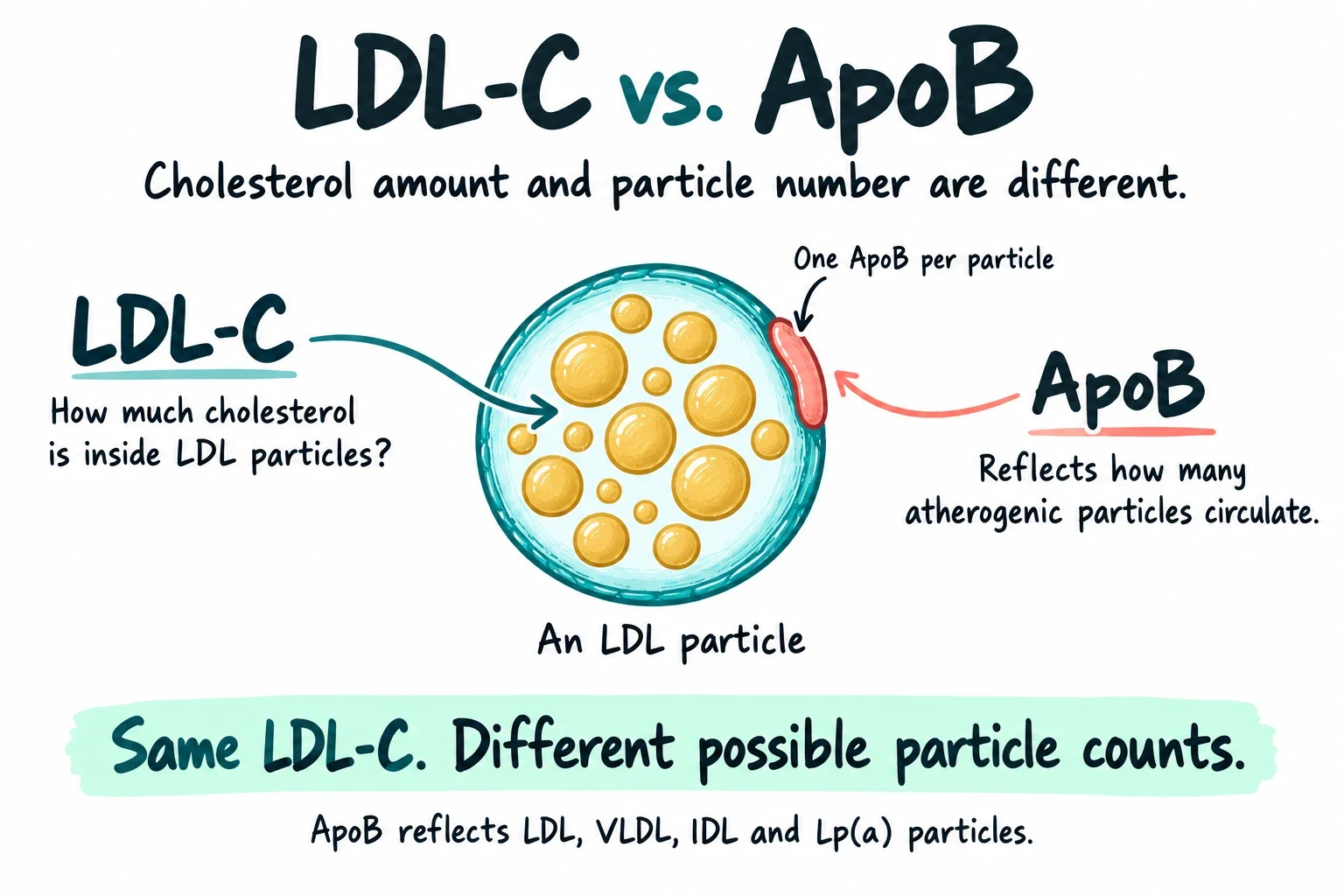
Apolipoprotein B is a protein on the surface of every particle that can form plaque: LDL, VLDL, IDL and lipoprotein(a). Each particle carries exactly one ApoB. Measure it and you have a direct count of the particles that can do vascular damage.
A standard lipid panel reports LDL-C, the amount of cholesterol inside LDL particles. It tells you how much cholesterol LDL carries, not how many particles you have. That is the blind spot. Many small particles, each carrying a little cholesterol, can produce a "normal" LDL-C with a high particle count and high risk. Fewer large particles can produce a higher LDL-C with less risk. ApoB counts every particle regardless of size, which is why it is the best single marker for cardiovascular risk, and why it is the number most likely to disagree with the cholesterol result you already have.
Why a normal test can miss it
Triglycerides are the usual reason. When triglycerides are elevated, often from insulin resistance, VLDL particles become enriched with triglycerides, get remodeled into small, dense LDL, and the ApoB particle count rises. LDL-C can read normal while ApoB is dangerously high.
So the people most likely to have a hidden ApoB problem are the people with high triglycerides, prediabetes or insulin resistance. They are also the people a standard panel is most likely to reassure.
Why it matters for your brain
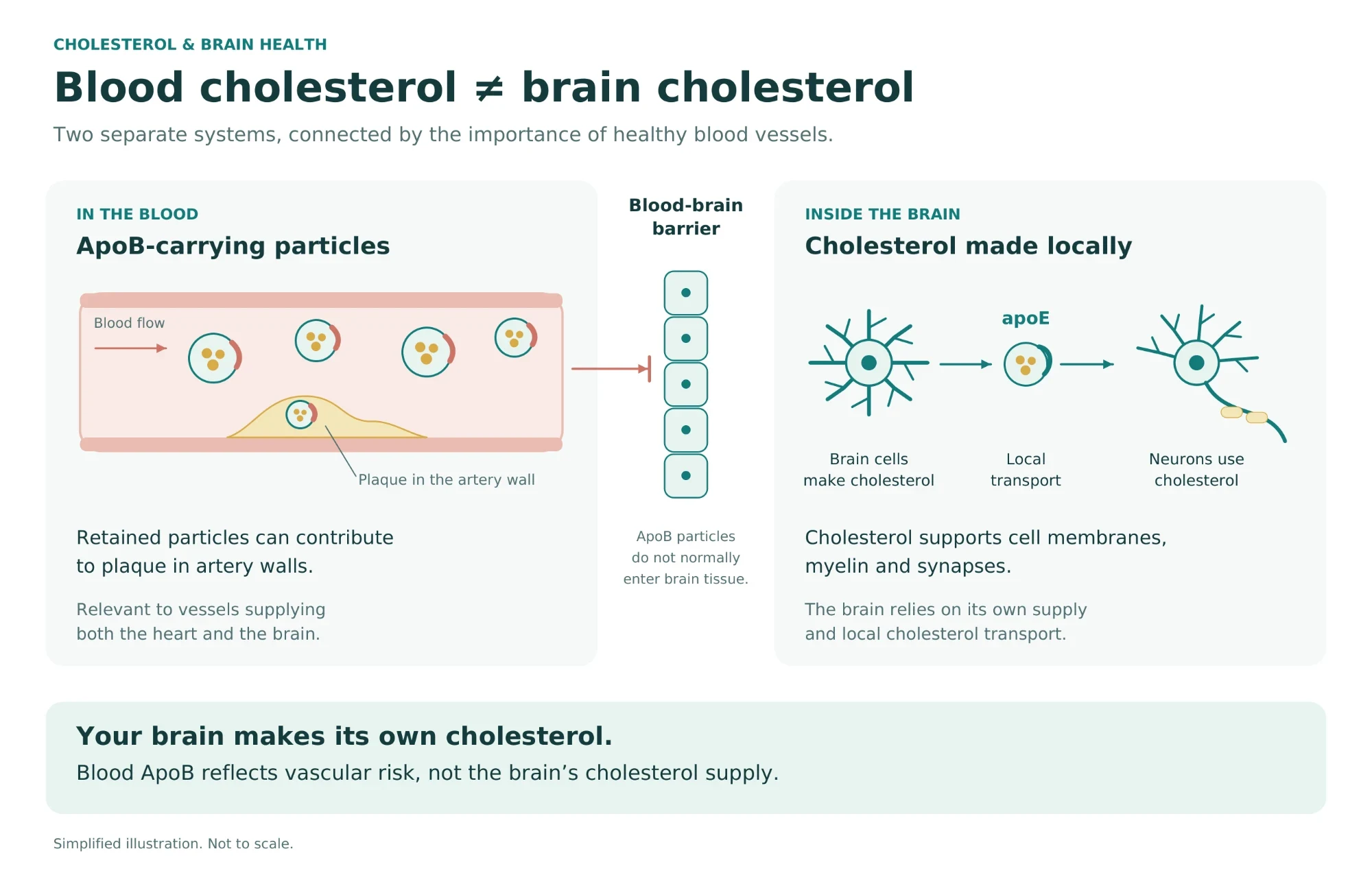
Your brain runs on blood flow. In the bloodstream, high ApoB drives atherosclerosis: particles penetrate artery walls, oxidize, trigger inflammation and form plaque. The same process that narrows a coronary artery narrows the carotid arteries in your neck and the smaller vessels inside the brain. High ApoB is cardiovascular and cerebrovascular risk at the same time, through the same mechanism.
The 2024 Lancet Commission on dementia added high LDL cholesterol to its list of modifiable risk factors. ApoB is the more precise way to measure the same vascular exposure. A 2024 genetic study found that genetically higher ApoB was associated with a shorter healthspan, with ApoB rather than LDL-C carrying that signal, and found preliminary evidence that it is associated with higher odds of Alzheimer's disease. The right verb is "associated with." Nobody can say today that lowering ApoB protects an individual brain. The reason to measure it is that it is a vascular risk you can both see and move.
One distinction matters here. The cholesterol in your blood and the cholesterol in your brain are two separate pools. The brain makes its own, packages it on a different protein (apoE), and the blood-brain barrier keeps blood cholesterol out. So a blood ApoB result measures what your arteries are exposed to, not what is inside your brain, and lowering it does not starve the brain of anything. Your brain keeps making what it needs regardless of your ApoB level. If you carry an APOE4 variant, that is a question about how your brain handles its own cholesterol, which is why APOE and ApoB are both on the panel and read together.
"Think of ApoB as the number of delivery trucks on a highway, while LDL-C is the amount of cargo inside them. Each truck has exactly one license plate, and that plate is ApoB. Counting plates tells you how many trucks are on the road, no matter how much each one is carrying. Trucks are what crash into the walls and get stuck, causing traffic jams. Someone could have a lot of small trucks each carrying a light load, so the total cargo looks normal, but the road is crowded and the risk of a pileup is high. LDL-C weighs the cargo. ApoB counts the trucks."
Emily Camiener, MPH, RDN, CDCES, Brain Health Coach at BetterBrain
When ApoB comes back high, the first lever is usually metabolic: triglycerides and insulin resistance are what push the particle count up. Read the four essential techniques our coaches keep recommending.
What a good ApoB looks like
There is no separate brain-specific ApoB target. The ranges come from cardiovascular medicine, and the brain benefits from the same healthy vessels. On the Blueprint panel, BetterBrain reads an ApoB above 90 mg/dL as poor, and above 108 mg/dL as the level directly linked to an increased risk of dementia. Those are the cutoffs behind the 47% and 22% figures above.
Most lab reports flag far higher than that. A standard report compares you to a population reference range built to catch people who are clearly abnormal. BetterBrain reads your result against the range associated with the lowest long-term vascular risk. A result can come back with no flag and still sit well outside the range you would choose for yourself.
What to do
ApoB is a standard blood test at any major lab. If your cholesterol has been called normal and you have high triglycerides, prediabetes or insulin resistance, or dementia or early heart disease runs in your family, ask your physician to add it to your next draw. Saying you want a particle count rather than a cholesterol mass is usually enough.
If it comes back above the optimal range, the levers are familiar and they are the same ones that protect the brain: metabolic health, lipid management and inflammation control. What a Brain Health Coach adds is sequencing. Most people have more than one marker worth working on, and knowing which to start with is the difference between a plan and a list. Do not change your medications based on a blog post; a result is a reason for a conversation with your clinician.
Most clients pay $0 with employer sponsored insurance.
Common questions
What is ApoB in simple terms?
ApoB is a protein attached to every cholesterol-carrying particle that can form plaque in artery walls. Each particle carries one ApoB, so measuring it gives you a count of those particles. A standard cholesterol test measures how much cholesterol the particles carry, a related but different number.
Is ApoB better than LDL cholesterol?
For cardiovascular risk, yes. ApoB counts every plaque-forming particle regardless of size, so it catches the case a standard panel misses: many small particles giving a normal LDL-C with a high particle count. For the brain, the link runs through the same vessels.
Can high ApoB cause dementia?
The evidence does not support "cause" as the word. High ApoB drives plaque in the vessels that supply the brain, and genetically higher ApoB is associated with higher odds of Alzheimer's disease. Whether lowering it changes an individual's thinking has not been shown.
Does lowering ApoB starve the brain of cholesterol?
No. The brain makes its own cholesterol and blood cholesterol cannot cross the blood-brain barrier. Your brain keeps making what it needs regardless of your ApoB level.
- One ApoB molecule per atherogenic particle. https://pmc.ncbi.nlm.nih.gov/articles/PMC5441126/
- LDL particle number vs LDL-C and cardiovascular risk. J Am Coll Cardiol. 2006. https://www.jacc.org/doi/10.1016/j.jacc.2006.09.043
- Triglycerides, small dense LDL and ApoB particle count. https://www.sciencedirect.com/science/article/pii/S1933287414004048
- Livingston G, et al. Dementia prevention, intervention, and care: 2024 report of the Lancet standing Commission. Lancet. 2024;404(10452):572-628. https://doi.org/10.1016/S0140-6736(24)01296-0
- Martin L, Boutwell BB, Messerlian C, Adams CD. Mendelian randomization reveals apolipoprotein B shortens healthspan and possibly increases risk for Alzheimer's disease. Communications Biology. 2024;7:230. https://doi.org/10.1038/s42003-024-05887-2
If your cholesterol has only ever been called fine, that may be the test, not the risk.
ApoB counts the particles that damage the vessels your brain depends on, and most people have never been told their number. Finding out is a routine blood draw. Reading it against the right range is where the work starts.