
Menopause Brain Fog: Causes, Symptoms, and What Helps
Menopause can affect memory and concentration. Learn what the studies show, how to recognize changes that need assessment, and where hormone therapy fits.
The menopause transition can affect thinking, including performance on cognitive tests. Sleep, mood and hot flashes can influence how foggy you feel. Hormone therapy has established uses for menopause symptoms and bone health, but dementia prevention remains unproven. A useful assessment combines symptoms, changes over time, relevant testing and clinical judgment.
Menopause brain fog describes changes in concentration, word finding and memory that can occur during perimenopause and menopause. Symptoms often fluctuate and improve after the transition. Understanding your pattern, sleep, mood and health history helps guide the next step. Persistent or worsening changes deserve a clinical assessment.
Brain fog has more than one possible contributor.
$0 with insurance for 92% of eligible clients.
What menopause brain fog feels like
You might lose your train of thought during a conversation, struggle to recall a familiar word, misplace something or find multitasking harder than usual. Some women notice mental fatigue or need more time to concentrate on work they previously handled easily.
These experiences can be frustrating, especially when they raise questions about long-term memory health. Menopause is one possible contributor among several. Our guide to brain fog symptoms and causes explains how sleep, medications, nutrient status, mood and other health factors can also be involved.
The Menopause Society describes concentration and memory complaints as common during the transition and the years immediately afterward. It also recommends discussing noticeable changes with a healthcare professional.
What the research shows about menopause and memory
The Study of Women's Health Across the Nation, or SWAN, has followed women through midlife with repeated cognitive testing.
A 2009 SWAN analysis of 2,362 women found that the usual improvement from repeating cognitive tests slowed during perimenopause. For processing speed, this was particularly apparent in late perimenopause. Improvement returned after the transition. This was a change in the benefit women gained from practice, rather than evidence that every participant developed a cognitive disorder.
A 2010 SWAN study examined whether depressive symptoms, anxiety, sleep disturbance and hot flashes explained the late-perimenopausal change in processing-speed test performance. They did not fully account for it.
A later analysis of 2,124 women, followed for a median of six and a half years, found gradual midlife cognitive aging. The estimated changes over ten years were about 4.9% in processing speed and 2% in delayed verbal memory scores. The researchers did not observe a sharp acceleration during or after menopause in that analysis, although most participants were already past the transition at its baseline.
Together, these findings help distinguish temporary changes around perimenopause from the gradual cognitive changes that can occur with aging.
Why brain fog can feel worse after a bad night
Sleep, mood and hot flashes can affect how well you function during the day. The relationship between those symptoms and formal test performance is more complicated.
For example, the SWAN research team’s cognition summary describes different associations for mood symptoms, self-reported sleep problems and objectively measured sleep disruption. Feeling foggy and performing differently on a test are related experiences, but they do not always change together.
That is why a useful conversation includes both your symptoms and what you are noticing in everyday life. For more on sleep's role in brain health, read our guide to deep sleep and the glymphatic system.
How long menopause brain fog lasts
Many women improve after the menopause transition, but there is no single timetable that applies to everyone. The return of practice-related gains in SWAN describes a group pattern, not a deadline for an individual's recovery.
If symptoms persist, your clinician can review other contributors and decide whether further evaluation would help. You can seek support while symptoms are affecting your life, without waiting for menopause to end.
How menopause brain fog differs from dementia
The British Menopause Society’s clinical guide emphasizes the pattern over time and the effect on daily functioning.
| Feature | Menopause-related brain fog | Dementia |
|---|---|---|
| Pattern | Often fluctuates with other symptoms | Typically worsens over time |
| Common difficulties | Word finding, concentration, misplaced items and losing a train of thought | May involve memory, language, judgment, orientation and completing familiar tasks |
| Independence | Usually preserved, even when work feels much harder | Increasing difficulty managing everyday responsibilities |
| Who notices | Often the person experiencing it | Family or other people may also notice changes |
These patterns help guide assessment; they cannot establish a diagnosis by themselves.
Discuss symptoms promptly if they are progressing, substantially affecting work or relationships, or creating safety concerns. Mention a family history of dementia beginning before age 65. Sudden confusion requires urgent medical assessment.
For more detail on the clinical evaluation, see how Alzheimer’s disease is diagnosed.
Can HRT help menopause brain fog?
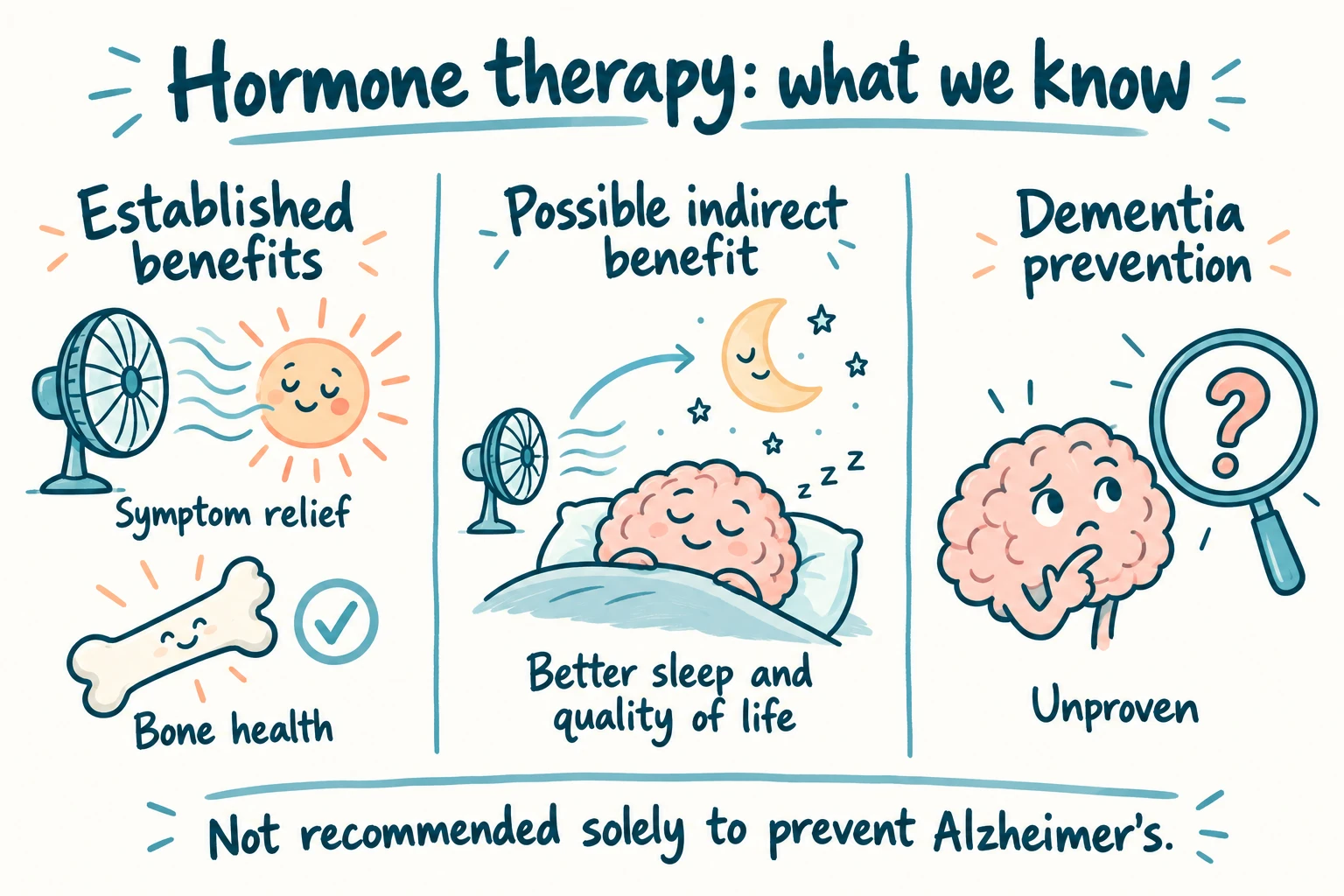
Hormone replacement therapy, also called menopausal hormone therapy or MHT, can treat symptoms that interfere with sleep and daily life. Some women may feel clearer when those symptoms improve. Evidence has not established HRT as a treatment to prevent dementia.
The Menopause Society’s hormone therapy guide describes established uses including relief of hot flashes and night sweats, treatment of vaginal symptoms, and protection against bone loss. The appropriate formulation and route depend on the symptom being treated and the person's health history.
Your clinician can help weigh the benefits and risks. The choice of treatment should reflect your symptoms, age, time since menopause, medical history and preferences.
What the newer hormone therapy studies found
An August 2026 study in Neurology found that estrogen-only therapy was associated with 35% lower odds of Alzheimer's pathology at autopsy and 39% lower odds of a dementia diagnosis. The American Academy of Neurology’s study summary explains that this was observational research and does not establish that treatment prevented dementia.
The Stanford research team’s account also describes limits on how broadly the results apply: the analysis concerned oral estrogen-only therapy, excluded topical treatment, and did not provide conclusive autopsy findings for combined estrogen-plus-progestin therapy. The participants were older than women usually beginning treatment for menopause symptoms today.
A 2025 systematic review and meta-analysis combined ten studies involving more than one million participants. It found no significant association between MHT and the risk of mild cognitive impairment or dementia, including in analyses by timing, duration and type. The UCL research team’s summary notes that the certainty of much of the evidence was low.
Hormone therapy may be appropriate for symptom management or bone health. Current evidence does not support starting it solely to prevent Alzheimer's disease, or treating a particular progesterone formulation as proven dementia protection.
For context on our earlier coverage, read the hormone therapy conversation in Grey Matters.
What tests can help evaluate brain fog
Your symptoms and medical history guide which tests are useful. There is no single blood test that determines whether brain fog is due to menopause or another cause, and standard cognitive screens can miss subtle changes.
A clinician may consider:
- Thyroid function: Tests such as TSH help assess thyroid function.
- Nutrient and iron status: Vitamin B12, a blood count and iron studies may help identify relevant deficiencies. Our article on iron and ferritin explains why iron status needs context.
- Metabolic health: Glucose and HbA1c can help assess blood sugar regulation. Our guide to fasting insulin and brain health explains a related marker.
- Other tests when indicated: Vitamin levels, liver and kidney function, and inflammatory markers may provide additional information. hs-CRP is an inflammation marker, not a test that identifies the cause of brain fog on its own.
Testing should support a clinical evaluation. An abnormal result does not automatically explain a symptom, and a normal result does not settle every question.
Alzheimer's biomarkers are a separate category. If your clinician thinks they are appropriate, our pTau-217 guide explains what those results can and cannot tell you.
What you can do about menopause brain fog
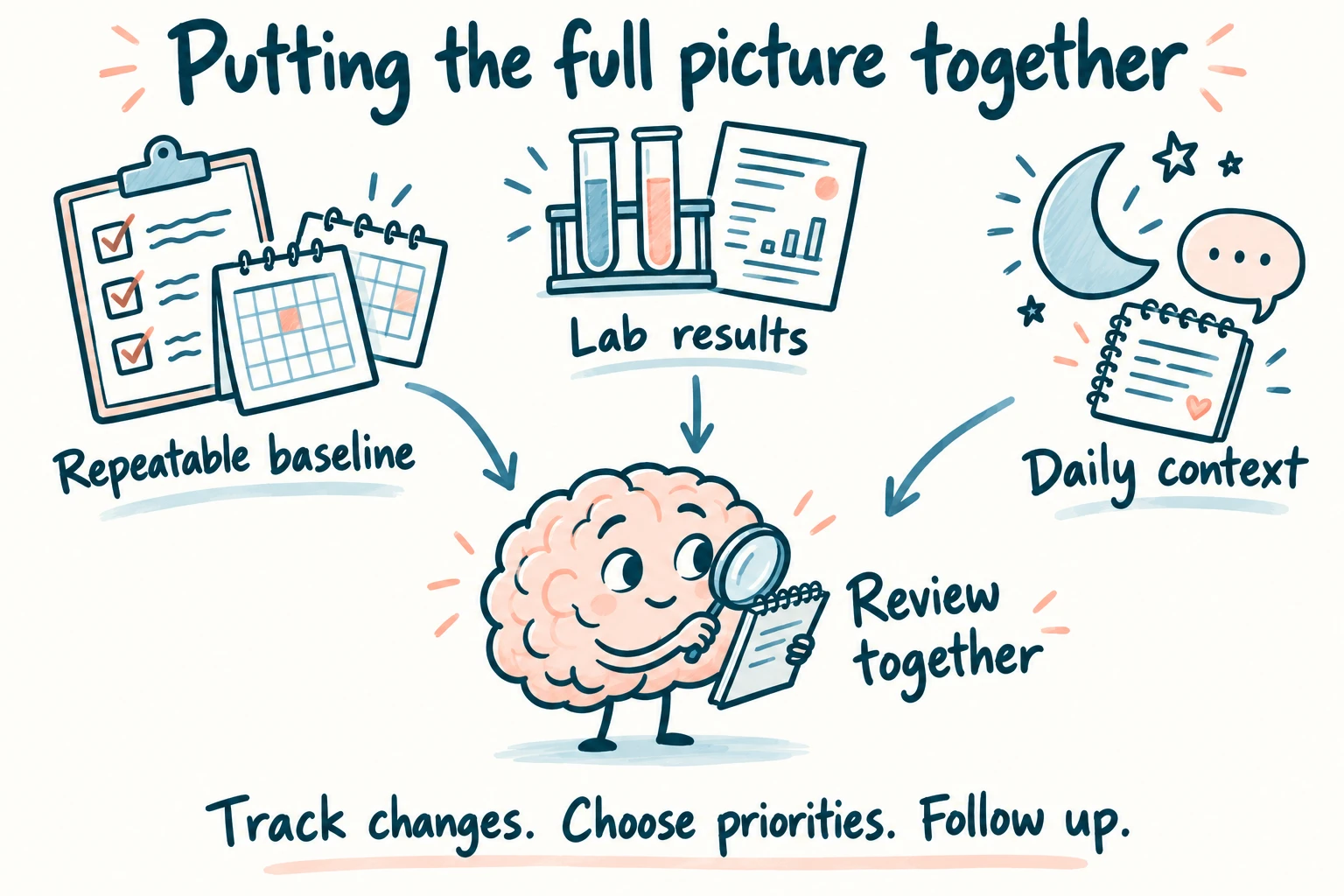
Start by collecting information that makes your next conversation more useful.
- Describe the changes. Bring specific examples: losing words, forgetting appointments, difficulty concentrating or struggling with tasks that used to feel easy.
- Track the context. Note sleep, hot flashes, mood, menstrual changes and when the fog is most noticeable.
- Discuss treatable contributors. Review medications, sleep problems, mood symptoms and relevant medical conditions with your clinician.
- Make daily tasks easier. Reminders, a quieter workspace, regular breaks and fewer simultaneous tasks can reduce the strain of a difficult day.
- Agree on follow-up. If a cognitive assessment is appropriate, ask how the result will be interpreted and when it should be repeated. Worsening symptoms deserve reassessment.
Personalizing a brain health plan with your own data can help organize these details and identify practical priorities.
How BetterBrain can support your next steps
BetterBrain brings together health history, lifestyle, relevant biomarkers and cognitive assessment to help you decide where to focus.
If you want to begin with testing, Blueprint includes 50+ brain-relevant biomarkers, a 15-minute cognitive assessment, and an expert consultation of up to 90 minutes. If you prefer ongoing support with habits and goals, the Coaching Program offers a dedicated coach, with testing available when appropriate.
BetterBrain supports brain health planning. A clinician evaluates persistent or progressive cognitive symptoms and determines whether diagnostic testing is needed.
This article is educational. Your healthcare professional can help assess symptoms and make treatment decisions.
Common questions
Can perimenopause cause forgetfulness?
Yes. Word-finding problems, distraction and forgetfulness are commonly reported during perimenopause. Other contributors can coexist, so persistent changes should be discussed with a clinician.
Does menopause brain fog mean I will develop Alzheimer's?
Brain fog alone does not establish Alzheimer's disease or predict that you will develop it. Changes in functioning and the pattern over time help determine what evaluation is appropriate.
Will HRT prevent dementia?
HRT has not been established as a dementia-prevention treatment. Decisions about treatment should focus on an individual's symptoms, bone health where relevant, and personal benefits and risks.
Can a normal memory test rule out menopause brain fog?
A normal cognitive screen can coexist with symptoms. Standard tests may miss subtle changes, which is why your history and everyday experience matter.
Is there a blood test for menopause brain fog?
There is no single diagnostic blood test for menopause brain fog. Clinically selected tests can help identify other contributors and provide information alongside symptoms and assessment.
- SWAN cognition fact sheet and study references. https://www.swanstudy.org/wps/wp-content/uploads/2023/04/SWAN-Fact-Sheets-Cognition.pdf
- Greendale GA, et al. Effects of the menopause transition and hormone use on cognitive performance in midlife women. Neurology. 2009. https://pubmed.ncbi.nlm.nih.gov/19470968/
- Greendale GA, et al. Menopause-associated symptoms and cognitive performance: results from the Study of Women’s Health Across the Nation. Am J Epidemiol. 2010. https://pubmed.ncbi.nlm.nih.gov/20442205/
- Karlamangla AS, et al. Evidence for cognitive aging in midlife women: Study of Women’s Health Across the Nation. PLoS One. 2017. https://journals.plos.org/plosone/article?id=10.1371/journal.pone.0169008
- British Menopause Society clinical guide on menopause and cognition. 2026. https://discovery.ucl.ac.uk/id/eprint/10230578/
- Bruno et al. Menopausal hormone therapy and Alzheimer’s outcomes. Neurology. 2026. https://www.neurology.org/doi/10.1212/WNL.0000000000218413
- Melville et al. Menopausal hormone therapy, mild cognitive impairment and dementia: systematic review and meta-analysis. 2025. https://pubmed.ncbi.nlm.nih.gov/41448220/
- The Menopause Society. Hormone therapy. https://menopause.org/patient-education/menopause-topics/hormone-therapy
Keep reading
Foggy days are worth understanding. Bring the full picture.
Symptoms over time, sleep, mood, health history and relevant tests are most useful reviewed together. A brain health coach can help you choose priorities and plan follow-up.