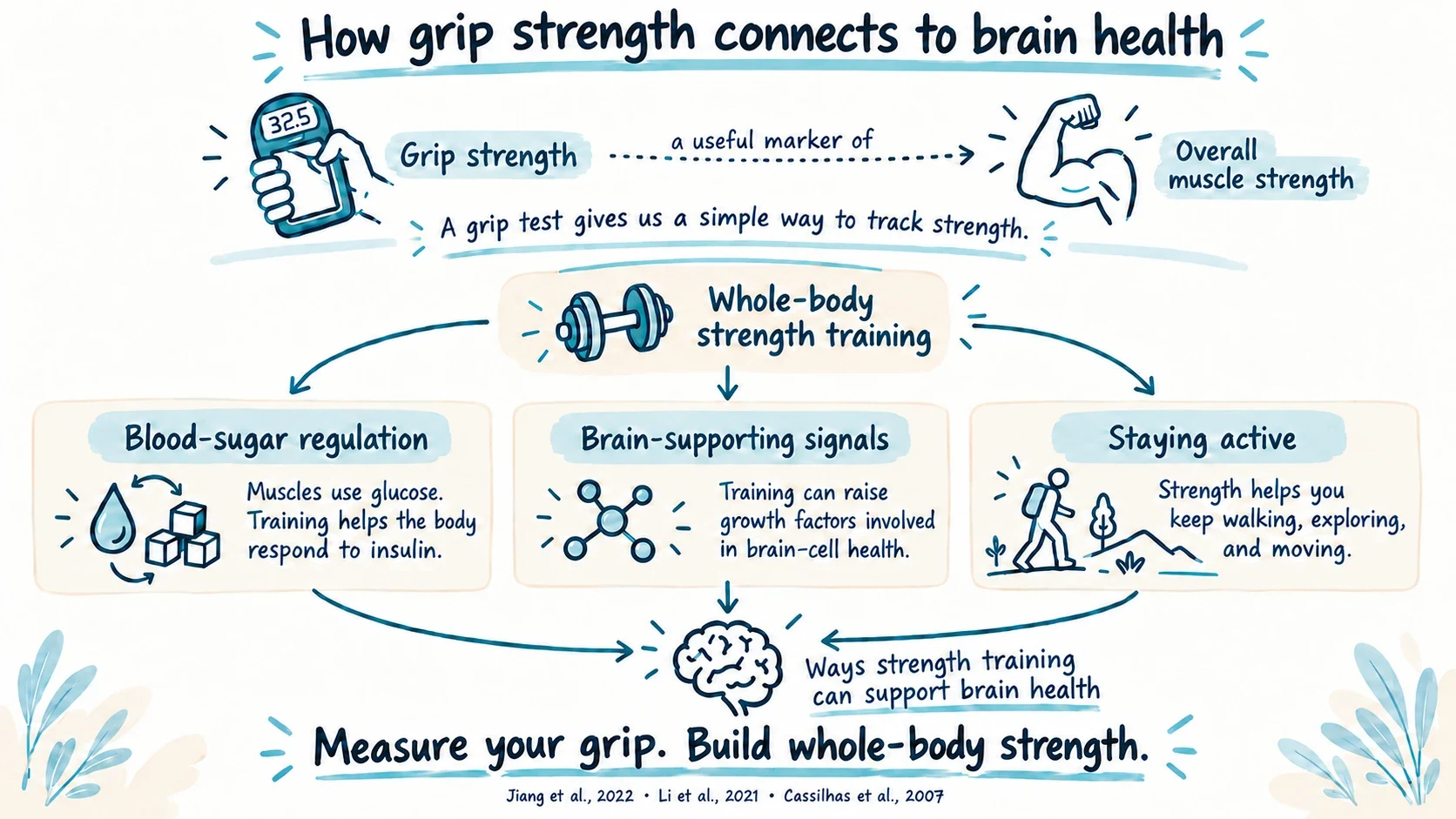

Key takeaways:
Most of the numbers that tell you something about your brain need a blood draw. This one needs a jar lid.
Grip strength keeps showing up in brain research, and for a measurement that takes a few seconds and costs nothing, it carries more information than most people expect. Here is what the studies have found, what they have not, and what to do with it.
The short answer
Grip strength is associated with brain health. In a UK Biobank study of more than 40,000 adults, stronger grip was associated with better performance on memory and reasoning tests and with more gray matter in the brain regions that handle both. A separate British study that followed adults from midlife found that weaker grip in their 50s and 60s was associated with lower reasoning scores and smaller brain volume around age 70. These are observational findings, so grip is a signal rather than a cause. It reflects overall muscle health, physical activity, cardiovascular fitness, and how well your nervous system communicates with your muscles. You can track it at home, the trend over time matters more than any single reading, and it improves with the same strength training that benefits the brain in other ways.
Why does grip strength show up in brain research?
Researchers like grip strength because it is fast, cheap, and consistent. It is measured with a small handheld device called a dynamometer: you squeeze, it records the force. That simplicity is why it appears in so many large cohort studies, and the large studies are where the brain connection shows up.
The UK Biobank analysis is the biggest. Across more than 40,000 participants, higher grip strength was associated with better scores on cognitive and memory tests and with greater gray matter volume in regions tied to memory and processing. The same paper found associations with mood and wellbeing, which fits the broader picture that brain health is whole-body health.
The midlife cohort adds the time dimension. Grip was measured at 53, in the early 60s and at 69, and brain scans and cognitive tests followed around age 70. Weaker grip in midlife was associated with lower nonverbal reasoning scores and smaller brain volume later in life, though not with most of the other cognitive tests.
A 2026 analysis went one step further and adjusted grip strength for body size. The adjusted measure appeared to be a stronger signal for cognition than raw grip alone, which suggests the link may run through the health of the nerve-to-muscle wiring itself rather than through muscle bulk. That work is early and still observational, but it points in the same direction: strength is telling you something about the nervous system, not only about the forearm.
Does weak grip strength cause cognitive decline?
No. The studies above are observational, which means they can show that grip and brain health move together, not that one drives the other. Your hands are not running your brain.
The more likely story is that grip is a readout of several things that do matter for the brain: how much muscle you carry, how much you move, how fit your heart and blood vessels are, and how well your nervous system is still talking to your muscles. Each of those has its own evidence base for cognitive health. Grip happens to summarize them in a single number you can check at home.
That makes it a dashboard light. It does not tell you what is wrong, and a low reading on one day means very little. A downward trend over a year or two is the version worth paying attention to.
How do you test grip strength at home?
You have two options, and the second one is free.
Use a dynamometer. Handheld grip dynamometers are inexpensive and widely available; the one we stock is the Handeful grip strength tester in BetterBrain Picks. Squeeze as hard as you can for a few seconds with each hand, record the best of two or three attempts, and repeat the measurement every few months under the same conditions: same time of day, same hand position, before any training. Normal ranges vary by age, sex, and which hand you use, so the number that matters most is your own reading compared with your last one.
Pay attention to the things you already grip. Opening jars, carrying grocery bags, holding a suitcase, hanging on to a steering wheel. If tasks that used to be easy are getting harder, that is the same signal without the device. Past 50, a gradual change over a year or two is worth noticing and worth bringing to your coach or your physician. Women should pay particular attention through perimenopause and menopause, when muscle loss tends to speed up, a point BetterBrain coach Wendy Pietri made in her Coach’s Corner on strength training.
How do you improve grip strength?
Grip improves alongside total-body strength, so the moves are the ones you would expect. Three that work:
- Carry heavy things. Farmer’s carries, a heavy bag of groceries in each hand, a kettlebell held at your side for a walk down the hall. Carrying a load under tension builds grip and whole-body strength at the same time.
- Hang and pull. Deadlifts, rows, pull-ups or assisted pull-ups, or simply hanging from a bar for as long as you can. Any movement where your hands have to hold on under load counts.
- Lift two to three times a week. That is the frequency at which the cognitive benefits of resistance training tend to show up, and grip follows overall strength. We covered the brain imaging evidence in what 6 months of lifting weights does to your hippocampus, and strength training is one of the five recommendations that appear most often in BetterBrain coaching plans.
Two supporting pieces. Muscle needs protein to respond to training, and most adults eat less than they think; how much protein do you actually need walks through the targets. And if a full gym routine is not realistic right now, one-minute exercise snacks are a legitimate on-ramp: a set of carries or a dead hang between meetings counts.
None of this requires chasing a specific number. The goal is keeping the whole strength system in good shape, because that system appears to be quietly connected to how your brain ages. The same loading that builds grip also builds bone, which we covered in the brain-building power hiding in your gym routine.
Where grip strength fits in the bigger picture
Grip is one signal among many, and on its own it will not tell you what to prioritize. Someone with insulin resistance, elevated ApoB, low B12, or poor sleep has a different first move than someone whose only finding is a softening grip. The value of a simple home measurement is that it can prompt the next question, and the next question is usually answered with bloodwork.
The BetterBrain Blueprint pairs 50+ biomarkers, including homocysteine and other brain-specific markers, with coaching to act on what they show. BetterBrain coaching is $0 for 92% of approved clients.
Check your eligibility for BetterBrain
Already a BetterBrain client? Open your BetterBrain dashboard and bring grip strength up at your next session. Your coach can help you decide whether it changes anything in your plan.
Frequently asked questions
What is a good grip strength for my age?
Normal grip strength varies by age, sex, body size, and which hand is tested, so there is no single target that applies to everyone. For brain health, your own trend over time is more useful than a comparison with a population table: measure under the same conditions every few months and watch for gradual decline.
Is grip strength linked to dementia risk?
Large observational studies have found that weaker grip is associated with lower cognitive scores, less gray matter in memory-related regions, and, in one cohort followed from midlife, lower reasoning scores and smaller brain volume around age 70. These studies show association, not cause. Grip reflects muscle health, activity, cardiovascular fitness, and nerve-to-muscle function, each of which has its own relationship with long-term brain health.
Can improving grip strength improve memory?
There is no good evidence that training grip in isolation improves memory. The grip-brain link appears to run through whole-body strength and fitness, and resistance training two to three times a week does have evidence behind it for cognitive benefit. Build total-body strength and grip comes along with it.
Do I need a dynamometer?
No. A dynamometer gives you a number you can track, and they are inexpensive (the Handeful grip strength tester is the one in BetterBrain Picks), but the everyday version works too: notice whether jars, bags, and other things you grip are getting harder to hold over months, and raise it with your coach or physician if they are.