
The everyday toxins affecting your brain health
Explore Moderate Toxins: 22 techniques across medications, food, and environment, and what the research says about a few that might feel familiar.
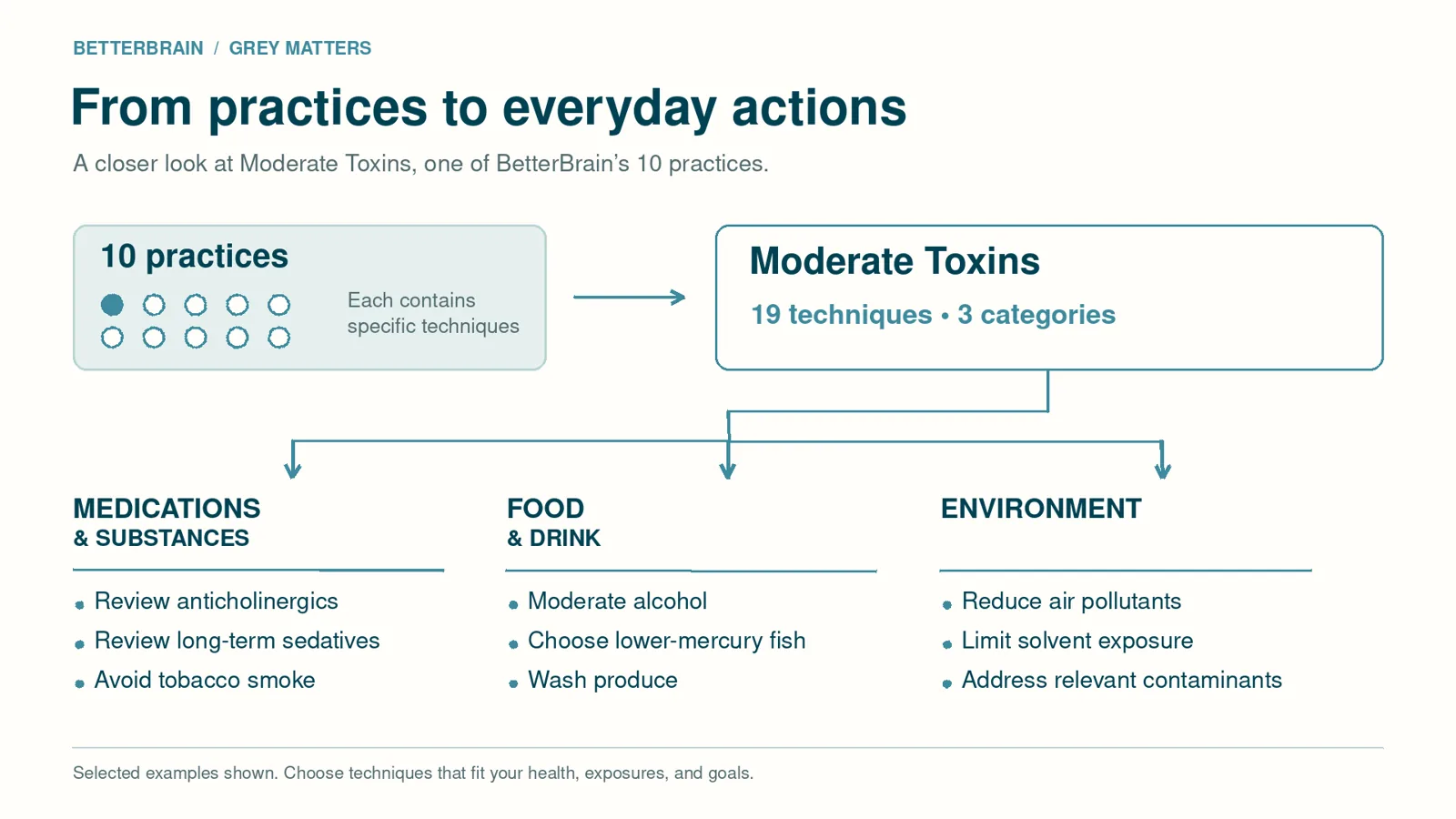
- Moderate Toxins is one of BetterBrain’s brain-health practices. It covers 22 techniques across three areas: medications and substances, food, and environment.
- Long-term, high cumulative use of strong anticholinergic medicines, including some sleep aids and allergy medicines, has been linked to a 54% higher rate of dementia in a 2015 study. This is an association, not proof of cause.
- Higher alcohol intake was associated with smaller brain volumes in brain scans of more than 36,000 adults.
- Choosing lower-mercury fish, rinsing produce, using a HEPA air cleaner, venting gas stoves outdoors, filtering water for lead, and storing food in glass or steel are practical ways to lower everyday exposure.
Most clients pay $0 with employer sponsored insurance.

“Toxins” is a word that gets used a lot in health advice, often without much explanation. It can leave you wondering how concerned to be about things you’ve used or eaten for years.
We think it helps to get specific. Which exposures show up regularly in your life? What do we know about them? And where would a change be worthwhile?
That’s the idea behind Moderate Toxins, one of BetterBrain’s 12 brain-health practices. It brings together 22 techniques across medications and substances, food, and environment. In this article, we take a closer look at a few that might feel familiar.
Medications and substances: can common sleep aids and allergy medicines affect your brain?
Some can, especially with long-term, regular use. A product you bought for a few restless nights can become something you reach for regularly. Familiar packaging makes it easy to skip over the active ingredient list, especially when it’s available without a prescription.
Some common allergy medicines and sleep aids have anticholinergic effects. That includes diphenhydramine, found in many Benadryl and “PM” products, and doxylamine, found in Unisom SleepTabs. These drugs block receptors for acetylcholine, a chemical involved in learning and memory. Certain bladder medicines and antidepressants do this, too.
Researchers have been studying what that might mean over time. In a 2015 study of 3,434 older adults, people with the highest cumulative use of strong anticholinergic medicines had a 54% higher rate of dementia. Their use added up to the equivalent of more than three years of daily doses over the previous decade.
The findings vary by medication. A larger 2019 study found associations for some anticholinergic drugs, but no significant association for antihistamines specifically. Neither study proves that the medicines caused dementia, and early sleep or mood changes can themselves prompt people to seek treatment.
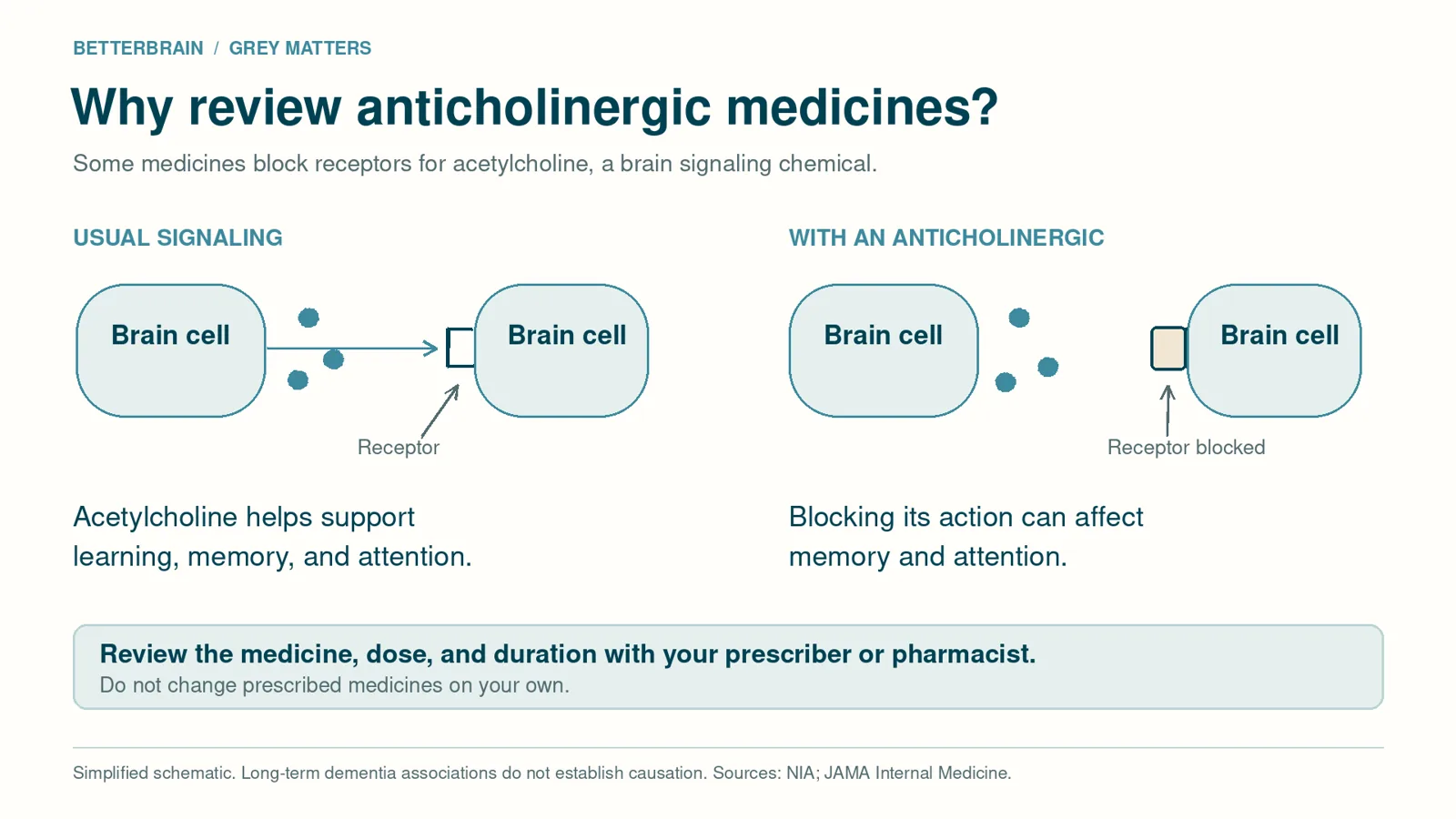
It’s a good reason to know what’s in the products you take regularly. Make a list, including anything you use for allergies or sleep, and bring it to a medication review with your prescriber or pharmacist. A Brain Health Coach can help you prepare your questions. For more on this question, read Does Benadryl cause dementia?
Food: which everyday foods and drinks matter for brain health?
That same attention to what you use regularly carries over to what you eat and drink.
With alcohol, it helps to look at the pattern across a typical week. In a study of brain scans from more than 36,000 adults, higher intake was associated with smaller brain volumes and differences in white matter, the connections between brain regions.
Looking at those weekly habits can also make grocery shopping a little more intentional. At the seafood counter, choosing lower-mercury fish lets you keep the nutritional benefits of seafood while limiting exposure. Salmon, sardines, and trout are all on the FDA’s lower-mercury list. If you tend to buy the same fish every week, this is an easy place to add some variety.
And when you get home with groceries, give your produce a rinse. Washing and scrubbing under running water can reduce some surface pesticide residues, though it won’t remove all of them. It’s a simple habit to build into preparing the fruits and vegetables you already enjoy.

Environment: how can you reduce toxins in the air, water, and containers at home?
Start with the spaces you use most. Once you’re home and cooking, there’s another part of the picture to consider: the air around you.
Fine particles, known as PM2.5, can come from combustion. A 2025 review of long-term air pollution and dementia found an association between higher exposure and dementia risk. A HEPA air cleaner sized for your room can help reduce indoor particles. For more on this, read Clearing the air: how pollution influences Alzheimer’s risk.
Gas stoves also produce nitrogen dioxide, which calls for a different approach. HEPA filters capture particles, while gases need other measures. The EPA recommends a range hood that vents outdoors. If you have one, turning it on while you cook is a habit worth keeping.
Water is worth considering, too, especially if lead or other heavy metals are a concern. Your local water-quality report or appropriate testing can help you choose a filter certified for the contaminant you want to reduce. Once it’s in place, staying on top of filter changes matters.
Along with the water itself, you might also think about what you store food and drinks in. Glass containers for leftovers and a stainless-steel bottle offer a straightforward way to reduce contact with plastic. The health research on microplastics is still developing; we see these swaps as reasonable precautions.
A few useful tools from Picks
For the changes that involve choosing a filter or replacing a container, we’ve gathered a few options in BetterBrain Picks:
- Coway Airmega 200M for filtering indoor particles. Check the room-size guidance and leave the optional ionizer switched off.
- Brita Elite filter pitcher for targeted water filtration. Its Elite filter is certified to reduce lead in compatible pitchers; check the performance sheet against your water needs.
- Caraway glass storage containers for storing leftovers in glass.
- Klean Kanteen bottle for a reusable stainless-steel option to carry through the day.
Browse the air, water and kitchen picks our team has gathered.
Frequently asked questions
What are everyday toxins for the brain?
They are regular exposures that research has linked to brain health. In BetterBrain’s Moderate Toxins practice they fall into three groups. Medications and substances include strong anticholinergic medicines, long-term sedatives, smoking, and alcohol. Food includes mercury in fish and pesticide residues on produce. Environment includes fine-particle air pollution (PM2.5), nitrogen dioxide from gas stoves, lead in water, and plastics.
Does Benadryl cause dementia?
It hasn’t been proven. Diphenhydramine, the active ingredient in many Benadryl and “PM” products, is anticholinergic. In a 2015 study, the highest cumulative use of strong anticholinergic medicines was linked to a 54% higher rate of dementia. A larger 2019 study found no significant association for antihistamines specifically. Both studies are observational. If you use a sleep or allergy aid regularly, review it with your prescriber or pharmacist. Don’t change a prescription on your own.
How does alcohol affect the brain?
In brain scans of more than 36,000 adults, higher alcohol intake was associated with smaller brain volumes and differences in white matter. Looking at your weekly drinking pattern is a useful place to start.
Which fish are lowest in mercury?
Salmon, sardines, and trout are on the FDA’s lower-mercury list. Choosing these lets you keep the nutritional benefits of seafood while limiting mercury exposure.
Does washing produce remove pesticides?
Partly. Washing and scrubbing under running water can reduce some surface pesticide residues, but it won’t remove all of them.
Do air purifiers help with gas stove fumes?
Not on their own. A HEPA air cleaner captures particles such as PM2.5 but not gases such as nitrogen dioxide. For gas stoves, the EPA recommends a range hood that vents outdoors, turned on while you cook.
REFERENCES
- Gray SL, Anderson ML, Dublin S, et al. Cumulative use of strong anticholinergics and incident dementia: a prospective cohort study. JAMA Internal Medicine. 2015;175(3):401-407. https://jamanetwork.com/journals/jamainternalmedicine/fullarticle/2091745
- Coupland CAC, Hill T, Dening T, et al. Anticholinergic drug exposure and the risk of dementia: a nested case-control study. JAMA Internal Medicine. 2019;179(8):1084-1093. https://jamanetwork.com/journals/jamainternalmedicine/fullarticle/2736353
- Daviet R, Aydogan G, Jagannathan K, et al. Associations between alcohol consumption and gray and white matter volumes in the UK Biobank. Nature Communications. 2022;13:1175. https://www.nature.com/articles/s41467-022-28735-5
- Best Rogowski CB, Bredell C, Shi Y, et al. Long-term air pollution exposure and incident dementia: a systematic review and meta-analysis. Lancet Planetary Health. 2025;9(7):101266. https://pubmed.ncbi.nlm.nih.gov/40716448/
- U.S. Food and Drug Administration. Advice about eating fish. https://www.fda.gov/food/consumers/advice-about-eating-fish
- U.S. Environmental Protection Agency. Pesticides and food: healthy, sensible food practices. https://www.epa.gov/safepestcontrol/pesticides-and-food-healthy-sensible-food-practices
- U.S. Environmental Protection Agency. Nitrogen dioxide’s impact on indoor air quality. https://www.epa.gov/indoor-air-quality-iaq/nitrogen-dioxides-impact-indoor-air-quality
- U.S. Food and Drug Administration. Microplastics and nanoplastics in foods. https://www.fda.gov/food/environmental-contaminants-food/microplastics-and-nanoplastics-foods