
Key takeaways:
Most clients pay $0 with employer sponsored insurance.
What the Lp(a)HORIZON trial found
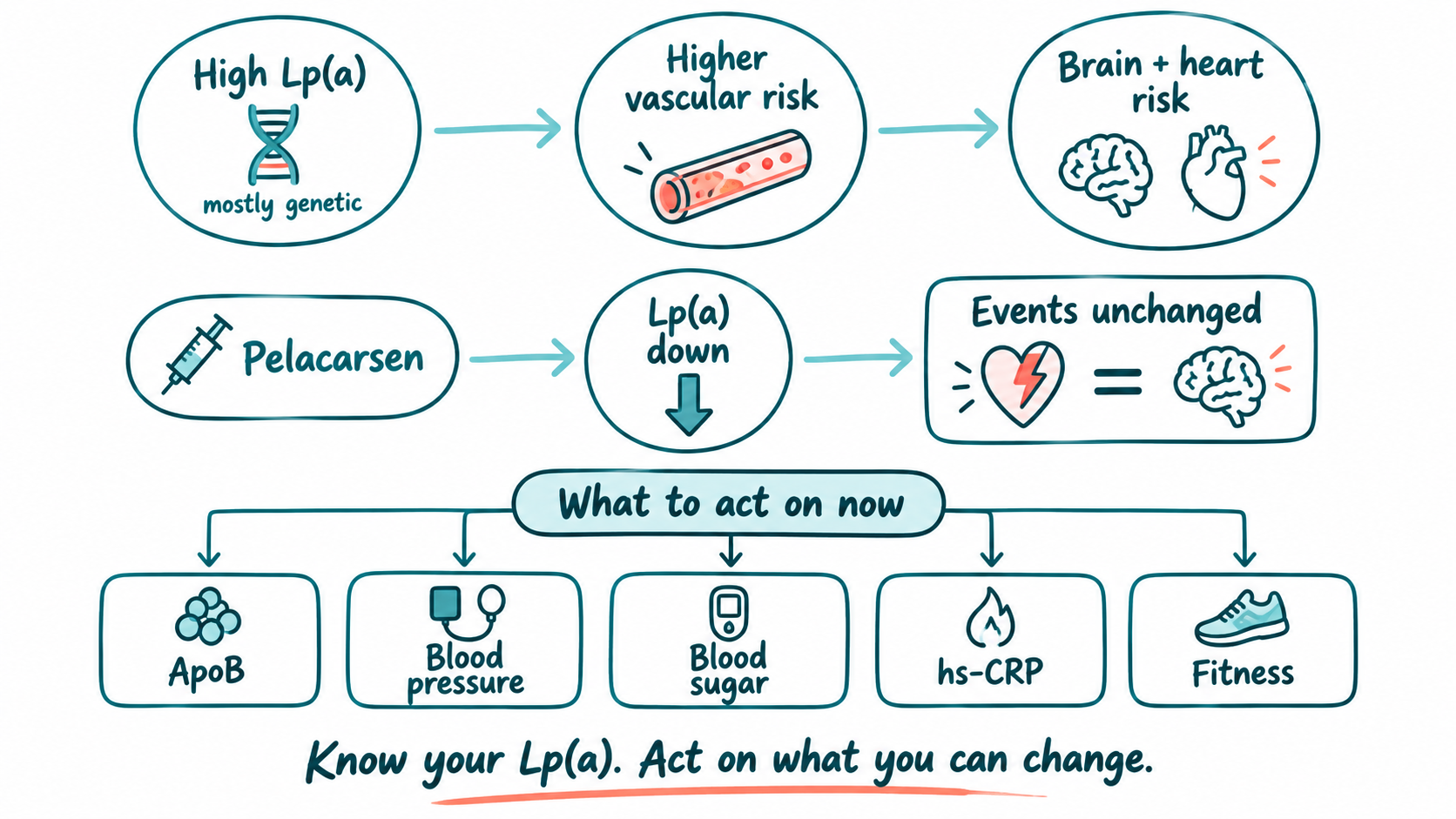
The short version: On September 4, 2026, Novartis announced that pelacarsen, its lipoprotein(a)-lowering drug, did not meet the primary goal of its Phase 3 trial. The drug lowered Lp(a). People taking it had heart attacks, strokes, and cardiovascular deaths at about the same rate as people on placebo.
That result surprised a lot of cardiologists. It is also a useful moment to explain a marker that sits on the BetterBrain panel and on very few standard cholesterol tests.
The trial, called Lp(a)HORIZON, enrolled 8,323 people who already had cardiovascular disease and an Lp(a) level of 70 mg/dL or higher. Participants received either pelacarsen or placebo on top of standard treatment for cholesterol and blood pressure. The question was whether lowering Lp(a) would mean fewer heart attacks, strokes, cardiovascular deaths, and urgent hospital procedures.
For this drug, in this group, the answer was no. In earlier studies pelacarsen had lowered Lp(a) by as much as 80 percent, and Novartis confirmed that levels came down in this trial as well. The combined rate of cardiovascular events did not.
Full data have not been published. Novartis says the results will be presented at an upcoming medical congress, so some of what follows will get sharper over the coming months.
What is Lp(a), in plain language
Lipoprotein(a), usually written Lp(a) and pronounced "L-P-little-a," is an LDL-like particle with an extra protein attached, called apolipoprotein(a). Three things make it different from the cholesterol numbers on a standard panel.
First, your level is set almost entirely by your genes. Diet and exercise barely move it.
Second, it stays roughly the same across your lifetime, which is why guidelines recommend measuring it once rather than every year.
Third, it is common and rarely tested. About one in five people has a high level, and high Lp(a) is associated with roughly a 40 percent higher long-term risk of heart attack or stroke. Yet in one analysis of 71 million US adults, only 0.1 percent had ever been tested. The 2026 ACC/AHA cholesterol guideline now recommends that every adult have Lp(a) measured at least once.
Why Lp(a) is a brain health marker
The stroke risk is why Lp(a) matters at BetterBrain. The vessels that feed your heart are the same kind of vessels that feed your brain, and vascular damage is one of the major pathways to cognitive decline. High cholesterol in midlife is now formally recognized as a modifiable dementia risk factor, and Lp(a) is one piece of that vascular picture. That is why it sits in the Blueprint panel alongside ApoB and hs-CRP.
Why a drug can lower the number and miss the outcome
This is the question cardiology is now arguing about, and nobody has the full answer yet. Three hypotheses are getting the most attention.
The reduction may need to be bigger
Lp(a) is measured in much larger units than LDL. A Mendelian randomization analysis estimated that Lp(a) would need to fall by about 66 mg/dL to produce the same heart benefit as a standard 39 mg/dL drop in LDL. For people starting near the trial's entry threshold, an 80 percent reduction may land right around that line. Two competing drugs, Amgen's olpasiran and Lilly's lepodisiran, lower Lp(a) by more than 90 percent, and their outcome trials are expected to read out in 2028 and 2029, with others behind them.
Everything else was already well controlled
Everyone in this trial had established cardiovascular disease and was already on aggressive treatment for LDL, blood pressure, and diabetes. When LDL has been driven very low and antiplatelet therapy is standard, there may be little room left for one more lipid-lowering drug to show a benefit over five years. The genetic studies that made Lp(a) look so important reflect a lifetime of exposure. Treating someone late, after decades of arterial damage and a first event, is a different experiment.
The number may not be the thing
Cardiologist Eric Topol wrote a sharp piece pairing the pelacarsen result with the failure of an anti-inflammatory heart drug in the ZEUS trial. His argument: both trials lowered a blood marker without confirming the marker was driving disease in those particular patients. Lp(a) particles carry oxidized phospholipids, which are thought to be the inflammatory cargo doing the damage, and a standard Lp(a) test does not tell you how much of that cargo a given person is carrying. Two people with the same Lp(a) can have very different amounts of inflammation in their arteries.
None of these is proven. What is clear is that a marker being causally linked to disease, which Lp(a) is, does not guarantee that a drug targeting it will help everyone with a high level.
The honest caveats
The full data are not out. Everything above is based on a topline announcement. The event rates, subgroups, and safety data will be presented at a medical congress later.
This was a secondary prevention trial. Everyone had already had a cardiovascular event or had established disease. The trial does not tell us what Lp(a) lowering would do in people who have never had an event.
One drug, one mechanism. Pelacarsen is an antisense oligonucleotide. Other Lp(a) drugs use different mechanisms and reach deeper reductions. Their results could differ.
The genetic evidence has not changed. Hundreds of studies link high Lp(a) to heart attack, stroke, peripheral arterial disease, and aortic stenosis. A failed drug trial does not undo that.
Our takeaway
We have watched this pattern before. Raising HDL looked like a great idea until the drugs that did it failed to prevent heart attacks. Lowering triglycerides with fibrates cleared the biomarker and did not move outcomes. In each case the lesson was the same: a biomarker is a signal about your biology, and the useful question is what that signal tells you to do differently.
For Lp(a), the answer today is the same as it was last month. Your number tells you how much genetic vascular risk you are carrying. It does not, yet, tell you to take a specific Lp(a) drug, because there is not one. What it does is raise the stakes on everything else that protects your blood vessels: the ApoB you can lower, the blood pressure you can control, the blood sugar and inflammation you can manage, the fitness you can build. High Lp(a) is a reason to be more aggressive on the levers that work, and the evidence for those levers did not change on September 4.
That is also why Lp(a) stays on our panel. A failed drug trial does not make a risk factor less real. It makes knowing about it early more important, because the tools you have are the ones that need time.
What this means for you, right now
If you have never had Lp(a) measured, get it done once. It is on every Blueprint panel. If you are already a BetterBrain client, your result is in the BetterBrain dashboard with your other vascular markers.
If your Lp(a) is high, push harder on what is proven. ApoB is the number to lower, through diet, movement, and, where your physician recommends them, medications. Blood pressure, blood sugar, and hs-CRP round out the picture. A BetterBrain coach can help turn that into a small set of priorities rather than a long list.
If you have already had a heart attack or stroke, the trial's most useful lesson is what modern secondary prevention looks like: every established risk factor treated aggressively, with your cardiologist.
If you want the background, we covered how to read a cholesterol panel in Cholesterol and your brain, and why ApoB matters more than LDL in our VERVE-102 issue.
Common questions
What is Lp(a) and why does it matter?
Lipoprotein(a) is an LDL-like particle with an extra protein attached. Levels are mostly inherited and stable over a lifetime. High Lp(a) is associated with higher long-term risk of heart attack, stroke, and aortic valve disease. About one in five people has an elevated level, and most have never been tested.
Did the pelacarsen trial fail?
Yes. The Lp(a)HORIZON trial of 8,323 people with established cardiovascular disease did not meet its primary endpoint. Pelacarsen lowered Lp(a), but the rate of cardiovascular death, heart attack, stroke, and urgent revascularization was not significantly different from placebo. Full results are expected at a medical congress later in 2026.
Does this mean Lp(a) does not matter?
No. The genetic and population evidence linking high Lp(a) to cardiovascular disease is strong and unchanged. The trial tested one drug in one group of already well-treated patients. It raises questions about how, when, and in whom Lp(a) lowering helps, not about whether Lp(a) is a real risk factor.
Should I still get my Lp(a) tested?
Yes. The 2026 ACC/AHA guideline recommends every adult have Lp(a) measured at least once. Knowing your number does not change the number, but it changes how aggressively you and your doctor treat the risk factors you can move. Lp(a) is included in every BetterBrain Blueprint panel.
Can I lower Lp(a) with diet or exercise?
Not meaningfully. Lp(a) is largely set by genetics. Some medications shift it modestly, but there is no approved therapy designed to lower it. The practical strategy is to lower the risk around it: ApoB, blood pressure, blood sugar, inflammation, and fitness.
Are other Lp(a) drugs still being tested?
Yes. Amgen's olpasiran and Lilly's lepodisiran both lower Lp(a) by more than 90 percent, and their outcome trials are expected in 2028 and 2029. Oral Lp(a) inhibitors are also in development.
How is Lp(a) connected to brain health?
Through your blood vessels. Lp(a) is associated with ischemic stroke, and vascular damage is one of the main pathways to cognitive decline. Protecting the vessels that feed your heart protects the ones that feed your brain.
Does BetterBrain test Lp(a)?
Yes. Lp(a) is part of the 50+ brain-relevant biomarkers in Blueprint, alongside ApoB, hs-CRP, homocysteine, and metabolic markers. Results are reviewed with a brain health coach who helps you decide what to act on first.
One number you can measure once, and act on for decades
Everything at BetterBrain starts the same way: your health history, your lifestyle, your brain-relevant health data, and a coach who helps you make sense of it, narrow it to a few priorities, and build a plan that adjusts as you go. The only thing you decide is where you start.
If you want to begin with your data, that is Blueprint: 50+ brain-relevant biomarkers including Lp(a), ApoB, and hs-CRP, cognitive testing, and a 90-minute consultation with a brain health coach. It starts at $89 with insurance. If you would rather talk to someone first, the Coaching Program starts with the conversation and adds testing later.