Vitamin D, winter, and your brain: what the research says
Shorter days mean less vitamin D for most people. Here is why that matters for long-term brain health, and the three other nutrient markers we check alongside it.
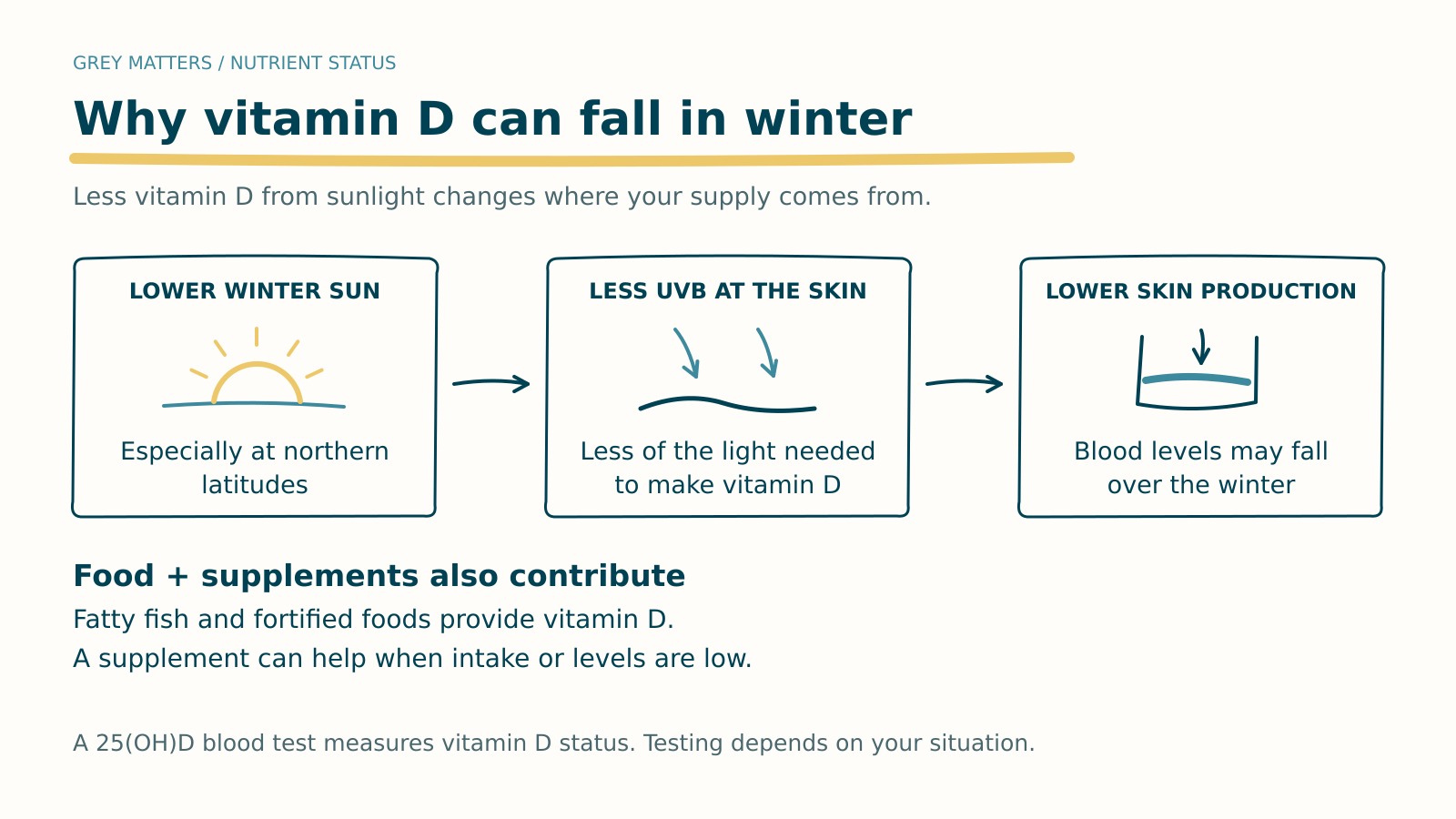
- Your skin makes vitamin D from UVB sunlight. In northern regions, winter sun provides very little UVB, so levels often fall from late fall through early spring.
- In U.S. national survey data covering 71,685 people, about one in three people tested in winter had vitamin D below 20 ng/mL, compared with fewer than one in five people tested in summer.
- In a study of 1,658 adults aged 65 and older, those with vitamin D deficiency had a 53% higher risk of developing dementia, and those with severe deficiency had a 125% higher risk. The study was observational, so it does not show that supplements prevent dementia.
- At BetterBrain, we aim to keep vitamin D between 40 and 80 ng/mL (100 to 200 nmol/L).
- When fatigue or brain fog is part of the picture, we look at vitamin D alongside vitamin B12, folate and ferritin.
Most clients pay $0 with employer sponsored insurance.
Vitamin D matters for the brain as well as the bones. Researchers have found vitamin D receptors in brain regions involved in learning and memory, including the hippocampus, and large studies link low vitamin D with a higher risk of dementia later in life. Because your skin makes vitamin D from sunlight, levels tend to fall in winter, which makes late fall a practical time to check yours.
As the days get shorter, most of us spend less time outside. The change in light shows up quickly in our routines and our energy. It also changes something we can’t feel directly: how much vitamin D our skin produces.
Why does vitamin D drop in winter?
Your skin uses UVB rays from sunlight to make vitamin D. How much it can produce depends on the season, where you live, your age and your skin pigmentation. In northern regions, winter sunlight provides very little of the UVB needed for that process. A bright winter day can still be a good day for a walk without doing much for your vitamin D level.
The seasonal drop shows up clearly in national data. In an analysis of U.S. National Health and Nutrition Examination Survey (NHANES) results from 2001 to 2018, about 33% of people tested in winter had levels below 20 ng/mL (50 nmol/L), compared with about 19% of people tested in summer. Being tested in winter was an independent predictor of severe deficiency.
How is vitamin D measured?
A vitamin D blood test usually measures 25-hydroxyvitamin D, written 25(OH)D. This is the form your liver produces after vitamin D enters your body through sunlight, food or supplements. Your kidneys and other tissues then convert it into the active form.
U.S. labs report results in ng/mL. Many other countries and most research papers use nmol/L. To convert, multiply ng/mL by about 2.5, so 20 ng/mL is 50 nmol/L and 10 ng/mL is 25 nmol/L.
What does vitamin D do in the brain?
Most people know vitamin D for its role in bone health. It helps your body absorb calcium, and its active form acts as a hormone that influences cells throughout the body.
Researchers have also identified vitamin D receptors in brain regions involved in learning and memory, including the hippocampus. Vitamin D helps regulate immune function and inflammation too, which adds to the scientific interest in how vitamin D status may affect the aging brain.
Is low vitamin D linked to dementia?
The strongest data comes from a 2014 study published in Neurology. Researchers followed 1,658 adults aged 65 and older from the U.S. Cardiovascular Health Study. None had dementia, cardiovascular disease or stroke when the study began, and they were followed for an average of about 5.6 years.
Compared with participants who had sufficient vitamin D (at least 20 ng/mL):
- Participants who were deficient (10 to 20 ng/mL) had a 53% higher risk of developing dementia.
- Participants who were severely deficient (below 10 ng/mL) had a 125% higher risk.
The association held after the researchers accounted for factors including age, smoking and body mass index.
This was an observational study, so it cannot show that low vitamin D causes dementia or that taking supplements would reduce the risk. The authors noted that the relationship could also run the other way: early changes from dementia can mean less time outdoors and a different diet, both of which lower vitamin D. They called for clinical trials to test whether raising vitamin D can delay or prevent dementia.
Our takeaway: low vitamin D is common, easy to measure and usually correctable, and the research gives good reason to take it seriously. If your level is low, work with your healthcare provider to understand why, bring it into range and decide when to recheck.
What vitamin D level does BetterBrain recommend?
Standard labs generally consider 30 ng/mL sufficient. At BetterBrain, we aim to keep vitamin D between 40 and 80 ng/mL (100 to 200 nmol/L).
For people below that target, supplementation is usually part of a winter plan, since sunlight alone may not provide enough. Your blood test helps your care team recommend an appropriate dose and decide when to recheck, so you can hold an adequate level through the colder months.
Three other markers we check alongside vitamin D
Vitamin D is one part of the nutrient picture our Brain Health Coaches look at. Vitamin B12, folate and ferritin each do different jobs, but reviewing them together is useful when someone has persistent fatigue or changes in concentration or energy.
Vitamin B12
Vitamin B12 helps maintain healthy nerves and make red blood cells. A deficiency can cause fatigue, memory problems or tingling, sometimes before any anemia appears. We pay particular attention to B12 in older adults, people who eat few animal foods, and people taking medications such as metformin or long-term acid reducers. Absorption is often part of the problem, so eating more B12-rich food does not always correct a low level.
Folate (vitamin B9)
Folate works with B12 in making DNA and recycling homocysteine. When either vitamin runs low, homocysteine can rise, which is one reason we interpret these results together. Leafy greens, beans and lentils provide folate. Low intake, absorption problems and heavy alcohol use can all contribute to deficiency. If folate supplementation is needed, B12 status should be checked too, because folic acid can correct the anemia of B12 deficiency while leaving its nerve effects untreated.
Ferritin (iron stores)
Ferritin shows how much iron your body has stored. Iron stores can run low before a standard blood count shows anemia, so a normal hemoglobin result does not always tell the whole story. Low stores are especially relevant for people with heavy periods or low iron intake, and they can be an overlooked part of a fatigue workup, as in Laura’s story. The next step is to find out why iron is low, then decide how to replenish it. Ferritin also rises with inflammation, so a higher number needs context before it can be read as good news.
What to do before winter
If you have been feeling unusually tired or foggy, look at your bloodwork before assuming it is just the season. These symptoms have many possible causes, and your history, diet, medications and lab results help a clinician decide next steps.
- Check your levels. Vitamin D, B12, folate and ferritin are all included in the BetterBrain Essentials panel.
- If vitamin D is low, ask about D3. A vitamin D3 supplement can raise your level, particularly in months when sunlight provides little. You can explore our recommended options in BetterBrain Picks.
- Use food as support. Fish, eggs and fortified foods contribute vitamin D or B12. Beans, lentils and greens provide folate and some iron. If you have a deficiency, the right mix of diet and supplements depends on its cause.
- Keep getting outside. A daylight walk supports your circadian rhythm and keeps you moving as the days shorten, even when the winter sun does little for vitamin D.
Frequently asked questions
Does vitamin D affect brain health?
Vitamin D receptors are found in brain regions involved in learning and memory, including the hippocampus, and vitamin D helps regulate inflammation. In a large study of older adults, people with vitamin D deficiency had a 53% to 125% higher risk of developing dementia than people with sufficient levels.
Why are vitamin D levels lower in winter?
Your skin makes vitamin D from UVB sunlight, and in northern regions winter sun provides very little UVB. In U.S. national data, about one in three people tested in winter had levels below 20 ng/mL, compared with fewer than one in five in summer.
Can taking vitamin D prevent dementia?
That has not been shown. The link between low vitamin D and dementia comes from observational studies, which cannot prove cause and effect. Keeping vitamin D in an adequate range is still a reasonable part of caring for your overall health, and it is simple to test and correct.
What is a healthy vitamin D level?
Standard labs generally consider 30 ng/mL sufficient, and levels below 20 ng/mL are commonly classed as deficient. BetterBrain aims to keep vitamin D between 40 and 80 ng/mL (100 to 200 nmol/L). Your care team can recommend a dose based on your result and decide when to recheck.
Can low vitamin D cause brain fog?
Low vitamin D is one of several nutrient issues worth ruling out when someone feels tired or foggy. Brain fog has many possible causes, so we look at vitamin D alongside B12, folate, ferritin, blood sugar regulation, thyroid function and sleep. Read more in Brain fog is not a diagnosis. It is a clue.
Should B12, folate and ferritin be tested with vitamin D?
When fatigue or concentration changes are part of the picture, yes. Each can contribute to low energy, and B12 and folate need to be read together because folic acid can mask the anemia of B12 deficiency. All four are included in the BetterBrain Essentials panel.
REFERENCES
- Littlejohns TJ, Henley WE, Lang IA, et al. Vitamin D and the risk of dementia and Alzheimer disease. Neurology. 2014;83(10):920-928. https://pubmed.ncbi.nlm.nih.gov/25098535/
- Cui A, Xiao P, Ma Y, et al. Prevalence, trend, and predictor analyses of vitamin D deficiency in the US population, 2001–2018. Frontiers in Nutrition. 2022;9:965376. https://www.frontiersin.org/journals/nutrition/articles/10.3389/fnut.2022.965376/full
- Eyles DW, Smith S, Kinobe R, Hewison M, McGrath JJ. Distribution of the vitamin D receptor and 1α-hydroxylase in human brain. Journal of Chemical Neuroanatomy. 2005;29(1):21-30. https://pubmed.ncbi.nlm.nih.gov/15589699/
- NIH Office of Dietary Supplements. Vitamin D: Fact Sheet for Health Professionals. https://ods.od.nih.gov/factsheets/VitaminD-HealthProfessional/
- NIH Office of Dietary Supplements. Vitamin B12: Fact Sheet for Health Professionals. https://ods.od.nih.gov/factsheets/VitaminB12-HealthProfessional/
- NIH Office of Dietary Supplements. Folate: Fact Sheet for Health Professionals. https://ods.od.nih.gov/factsheets/Folate-HealthProfessional/